
****************************************************************************************
*******************************************************************************************
*****************************************************************************************
By Steve Collins / Photos by Bruce Ackerman
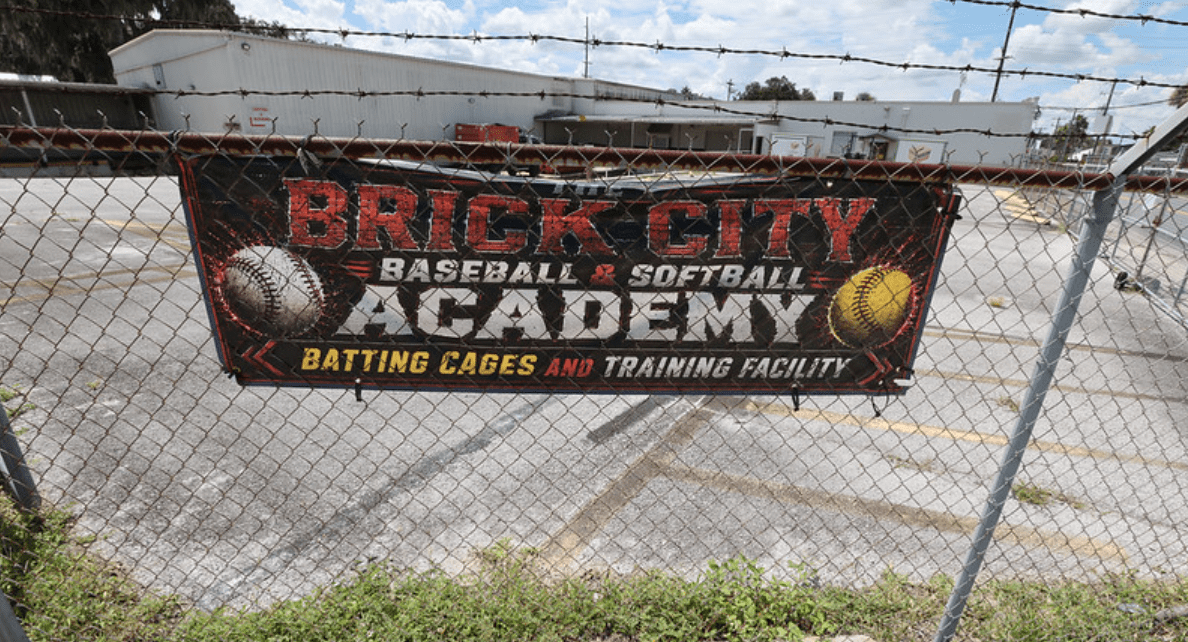
John Ivory was browsing Facebook on his phone when an ad for the Brick City Academy popped up. As a baseball dad who coaches two travel teams, he was excited to learn there would soon be indoor batting cages, an artificial pitching mound and youth baseball instruction in downtown Ocala.
“My first thought was this is amazing; I can’t wait to have this for my kids,” Ivory said.
To Ivory’s frustration, it now appears that Brick City Academy will never open its doors in Marion County. The co-owners announced on Facebook Sept. 10 that they can’t afford to open because they’ve been hit with more than $100,000 in county impact fees.
It’s news that could affect more than the youth sports community as impact fees are expected to continue to rise in the coming years, making it more costly to open many businesses. The fate of the aging downtown building the academy’s co-owners were hoping to spruce up also remains unclear.
The men behind the mission
Brick City Academy was to be the dream of two men who found themselves searching for their next move in life.
John Prosoco had run the Ocala franchise of The Hitting Academy, an indoor baseball and softball training center, but closed the doors in February after two and a half years when his landlord raised the rent. Prosoco said when he became a Hitting Academy franchisee, he went through rigorous training to become a hitting instructor.
He said he wasn’t ready to move onto something else after closing the doors of his franchise.
“I can do other things, but this is what I’m good at,” Prosoco said.
Jared Johnson had recently sold his dumpster business and was looking for something that would allow him to spend more time with his family. He figured his business acumen could be combined with Prosoco’s talents to help fill a need in a community with a growing number of youth baseball and softball players.
They found a vacant building near Osceola Middle School that had previously been used as a warehouse by Marion County Public Schools. The property would need to pass city code inspection and an initial meeting with city officials went well.
“My agent said he’d never had a meeting with the city go so well,” Johnson said. “They were very excited.”
Johnson and Prosoco signed a lease that began in July with a $28,000 deposit and set about spending what Johnson describes as “tens of thousands of dollars” to get ready for opening day. There was close to $10,000 a month on rent, $2,000 for rubber flooring, $10,000 on turf and netting, and on it went.
The goal was to be open by mid-August, in time for fall baseball season. They were getting close when the bill for the impact fee came in. Johnson said nobody ever mentioned an impact fee until his contractor told him they’d received a bill. He said he was surprised but assumed the amount was something that could be absorbed. Instead, it was more than $100,000.
At first, Johnson and Prosoco assumed something could be done. They worked with city and county officials to find a compromise, but it eventually became clear the final authority fell to the county and the county wasn’t budging. County Commissioner Craig Curry, whose district includes the property, said the ordinance covering impact fees doesn’t allow the county to make exceptions except in cases where somebody hires a firm to do their own impact study.
Johnson said when it became clear their existing property would be prohibitively expensive, he and Prosoco began to work with the county to find other potential properties. However, they weren’t able to find a property with impact fees of less than $50,000.
“We might have to move to a different county,” Prosoco said. “We don’t want to do that, but we might have no other choice.”
Mike Boyle, owner of Boyle Construction, was the contractor on the Brick City Academy project. He said he was shocked to hear how much impact fees would be.
“Impact fees were almost double what construction would’ve been,” Boyle said. “That’s a killer.”
What’s an impact fee?
Impact fees are most often associated with new construction, as a fee local governments charge developers for building new houses or commercial developments. The idea is that new construction places a strain on existing infrastructure and that developers rather than taxpayers should pick up the tab.
Although it’s true that impact fees apply to new development, it’s also true that when a business moves into building and wants to use it in a different way than the building has previously been used, an impact fee may be required before a certificate of occupancy is granted.
“It’s important to note that impact fees are based on the type and intensity of a proposed use, not simply on whether a building already exists. Different uses can place different demands on public facilities, including the transportation system,” according to an email from Stacie Causey, public relations manager for the Marion County Board of County Commissioners.
The county breaks new development into dozens of land-use categories, with each assessed a different rate based on how much traffic a particular use is expected to generate. The more expected traffic, the higher the fee. For that reason, the impact fee for a warehouse is different from a medical office, which is different from a car wash.
Impact fees are a one-time fee, so once an impact fee has been paid for a particular use, that use is covered for life in that particular building. However, if somebody wants to switch to a heavier use, that comes with additional impact fees.
“In the case of Brick City Academy, the proposal involves changing an existing building’s use from warehouse space to indoor batting cages,” according to Causey’s email. “For impact fee purposes, indoor batting cages fall within the county’s racquet club/health spa land-use category, which has a different transportation impact fee rate than a warehouse because the uses are expected to generate different levels of transportation demand.”
For Brick City Academy, the change in use proved costly. The impact fee for the racquet club/health spa land-use category is $10,858 for every 1,000 square feet. By comparison, the fee for a warehouse is $529 per 1,000 square feet. With Brick City Academy planning on using 12,500 square feet of the building, after factoring in the credit for the previous use, the co-owners would’ve been on the hook for a little more than $129,000. Johnson says they were originally told the property would be classified as a Recreational Community Center, but even with that classification, it would’ve cost nearly $102,000.
A history lesson
Understanding how we got here requires also understanding where we came from.
On the heels of the global financial crisis, the county halted all impact fees in 2010. It would reinstate fees with a 2015 ordinance, but those fees didn’t kick in until 2017. That means that all the growth Marion County experienced over a roughly seven-year period, and there was a lot of it, came without developers having to kick in impact fees. And when fees did return, they were at rates much lower than the rates the county’s consultants had suggested.
The rates weren’t raised again until October 2025. This time, fees rose dramatically. The impact fees that the Brick City Academy co-owners would have paid had they opened this summer while classified as a racquet club/health spa would have been 426 percent higher than what they’d have paid had they opened before the county raised rates in 2025. Similarly, the impact fee for a new full-service restaurant would be 369% higher today than in September of 2025.
It appears to Ivory that after years of giving developers a free or reduced ride, now the county is trying to play catch-up, but guys like Johnson and Prosoco are the ones paying the price.
“Now it’s the local family-owned businesses that are getting choked out,” Ivory said. “Not the developers.”
A quirk in the system
Not all businesses are affected in the same way. Novel businesses, such as Brick City Academy, are disproportionally affected because there are fewer existing properties where the impact fee has already been paid. For example, somebody looking to open a smoke shop in Ocala would likely have a lot less trouble finding a building where the impact fee has already been paid than somebody with batting cages.
The other challenge is that impact fees must be paid in full before the doors open. Big developers and national chains have that kind of money on hand. Folks hoping to open a small business often don’t. Ironically, if Johnson and Prosoco had pulled together the money for the impact fee and later went out of business in part because they were carrying additional debt, somebody else could walk in and start the same business with zero impact fees.
If there are flaws in the system, the county commission’s Curry said it isn’t for a lack of trying.
“We spent an inordinate amount of time studying impact fees,” Curry said.
Rising costs
As high as they may be, impact fees are only headed higher. Although the impact fees that Johnson and Prosoco would have paid were 426 percent higher than the previous year, that’s nothing compared to the 651% increase they’d have faced had they waited until Oct. 1, 2028.
When the Marion County Board of County Commissioners voted to increase impact fees in 2025, the commissioners chose to phase in the new rates over four years. The rates Johnson and Prosoco were quoted were just 70% of what they’ll be in a little more than two years. The rates will go up another 10% every Oct. 1 until they hit 100%.
The future of a vacant building
The future of the aging building at 506 S.E. 3rd Ave. remains unclear. That frustrates Johnson.
“This building is just rotting downtown and you get somebody who wants to spend money to fix it up and then this happens,” Johnson said.
Only time will tell if somebody else will step up and fill the space. David King, the architect on the Brick City Academy project, has a piece of advice for anybody considering it. It’s the same advice he’d give anybody looking to open a business, regardless of location.
“Please do not forget to check the impact fees before your start,” King said.
Anybody who checks those impact fees may well come to the same conclusion that Johnson and Prosoco did. Because impact fees for warehouses are so much lower than those for many other businesses, there may well be some sticker shock for anybody hoping to turn the space in to something other than a warehouse. Even without batting cages, the switch won’t come cheap.
“It will end up being a homeless area, you watch,” King said.
Hard feelings
Ivory is left thinking of what could have been. He said the county is home to many talented youth baseball players, but Marion County lacks the kind of infrastructure that allows young athletes to reach their full potential. He said he’s not the only one who’s disappointed Brick City Academy won’t open.
“Everybody in the entire baseball community is upset about it,” he said.
Now that his excitement about the promise of Brick City Academy has turned to disappointment, one thing is clear to Ivory.
“Our local government officials aren’t supporting our kids,” Ivory said.
First published in the Ocala Gazette

9 photos




 English