
<ins class='dcmads' style='display:inline-block;width:728px;height:90px'
data-dcm-placement='N46002.3910832MAHOGANYREVUE/B29181624.356591058'
data-dcm-rendering-mode='iframe'
data-dcm-https-only
data-dcm-gdpr-applies='gdpr=${GDPR}'
data-dcm-gdpr-consent='gdpr_consent=${GDPR_CONSENT_755}'
data-dcm-addtl-consent='addtl_consent=${ADDTL_CONSENT}'
data-dcm-ltd='false'
data-dcm-resettable-device-id=''
data-dcm-app-id=''>
<script src='https://www.googletagservices.com/dcm/dcmads.js'></script>
</ins>
***********************************************************************************
***********************************************************************************
***********************************************************************************
The judge who sentenced her thought he was teaching her a lesson.
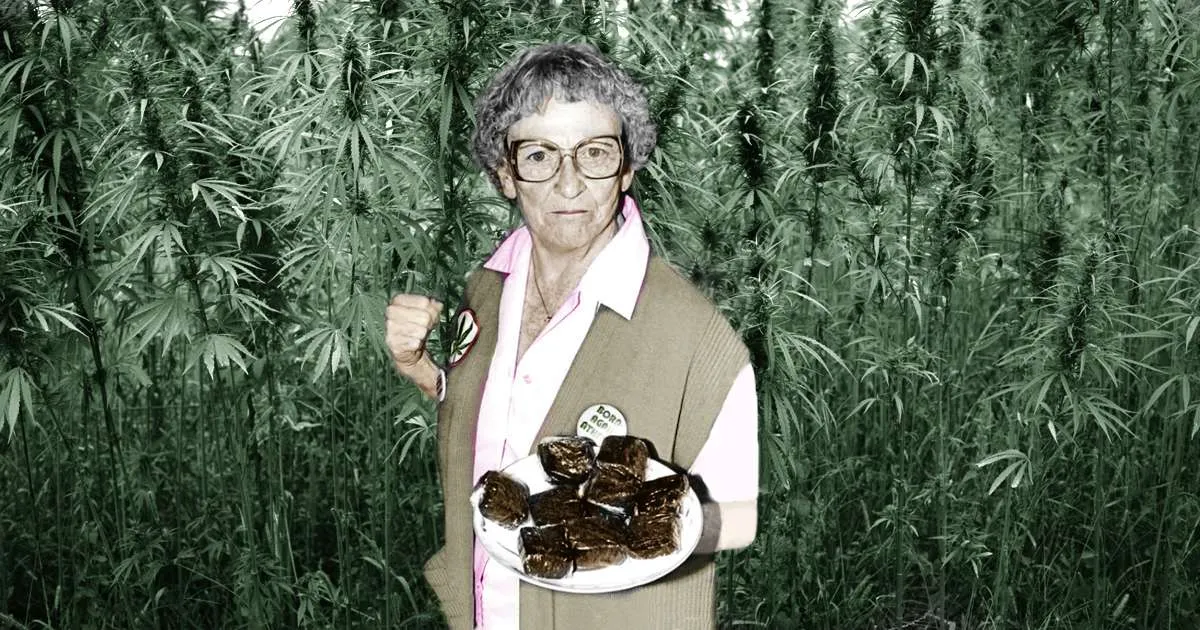
San Francisco, 1981. Police kicked in the door of a small apartment expecting a dealer and found a fifty-seven-year-old waitress in an apron.
The place smelled of chocolate. On the counter, cooling on wire racks, were fifty-four dozen brownies. They bagged up around eighteen pounds of marijuana and put handcuffs on her.

She didn’t look frightened or guilty. She smoothed down her apron and told them she’d been expecting them.
The headlines wrote themselves. A grandmother running a pot bakery. A funny local story about an older woman misbehaving.
Nobody looked closely enough to ask who the brownies were for.
To understand it you have to remember what San Francisco was in the early eighties.
Something was moving through the city and killing young men, and nobody had a name for it yet. Families were disowning their sons. Landlords were evicting tenants. And in some hospitals, staff who were frightened of a disease nobody understood would leave food trays outside the door rather than go into the room.
Young men in their twenties were wasting away and dying alone.
Mary knew what losing a child was. Her daughter Peggy had been killed in a car accident in 1974 at twenty-two, and it had taken something out of her that never came back.
When she was sentenced for that first arrest, the judge gave her five hundred hours of community service, presumably expecting the work to sober her up.
He sent her to San Francisco General Hospital.
She walked into the AIDS wards at a time when other people were walking out of them. No mask, no gloves, no holding her breath. She saw rows of skeletal young men in agony and frightened out of their minds.
She started calling them her kids.
She mopped floors and changed sheets. And then she noticed something the doctors were losing sight of.
The medication those men were on caused violent nausea. They couldn’t keep anything down. They were starving to death at the same time as the virus was killing them.
And Mary knew something about the brownies she’d been arrested over.
They settled a stomach. They brought an appetite back. They let a man in pain sleep for a few hours.
So she went home and turned the oven on.
She lived on social security that barely covered the rent, and spent nearly all of it on flour and sugar and butter. The cannabis came free — local growers heard what she was doing and started leaving it at her door.
Then she packed a basket and took the bus to the hospital.
She went room to room. She sat with men who hadn’t seen their own mothers in years, because their mothers wouldn’t come. She held their hands and told them jokes and gave them a brownie and told them to eat it, baby, it’ll help.
And nurses watched patients who hadn’t eaten in days start asking for food.
For more than a decade that was her life. Roughly six hundred brownies a day. Fifty pounds of flour a week.
She washed their pyjamas. She went to their funerals. She held a great many of them while they died.
All of it during the War on Drugs.
In 1992, at seventy, she was arrested again — and this time it was felonies, and prosecutors who looked at her record and saw a repeat offender. One of them reportedly said he was going to kick this old lady’s backside in court.
They had no idea what they’d picked up.
They thought they had a dealer. What they actually had was the most beloved woman in San Francisco.
When the news broke, the city went up. Not just activists — doctors, nurses, and parents who had watched her care for their dying sons when nobody else would.
She turned the trial into a platform. Reporters asked whether she was afraid of prison, and whether she’d stop if they let her off.
She told them that if the narcs thought she was going to stop baking for her kids with AIDS, they could go do something anatomically ambitious to themselves in the window of Macy’s.
It ran in papers across the country.
Doctors from San Francisco General wrote to the court saying her brownies were medically necessary. Patients testified. The charges were dropped.
And she didn’t go home to rest, because her own acquittal didn’t help anyone still in a bed.
She teamed up with Dennis Peron and opened the San Francisco Cannabis Buyers Club — the first public dispensary in the United States.
Then she campaigned for Proposition 215, travelling the state in failing health, arguing in plain language. Not about liberty or tax revenue. About pain, and about compassion, from a grandmother who had sat with more dying men than most doctors.
In 1996 it passed, and California became the first state to legalise medical cannabis. Everything since has followed from that.
She used to joke that if it ever became legal she’d sell her recipe to Betty Crocker and buy a big house for her patients to live in.
She never sold it. She died in 1999, at seventy-seven, in a nursing home, with no money.
Most of the millions of people now using it legally for pain and nausea and seizures have never heard her name.
They don’t know about the six hundred a day, or the bus rides, or the funerals.
A court sent a woman to do her penance in an AIDS ward.
It was the worst sentencing decision in the history of American drug law, and the best thing that ever happened to those men.




 English