
<ins class='dcmads' style='display:inline-block;width:728px;height:90px'
data-dcm-placement='N46002.3910832MAHOGANYREVUE/B29181624.356591058'
data-dcm-rendering-mode='iframe'
data-dcm-https-only
data-dcm-gdpr-applies='gdpr=${GDPR}'
data-dcm-gdpr-consent='gdpr_consent=${GDPR_CONSENT_755}'
data-dcm-addtl-consent='addtl_consent=${ADDTL_CONSENT}'
data-dcm-ltd='false'
data-dcm-resettable-device-id=''
data-dcm-app-id=''>
<script src='https://www.googletagservices.com/dcm/dcmads.js'></script>
</ins>
*********************************************************************************
*********************************************************************************
*********************************************************************************
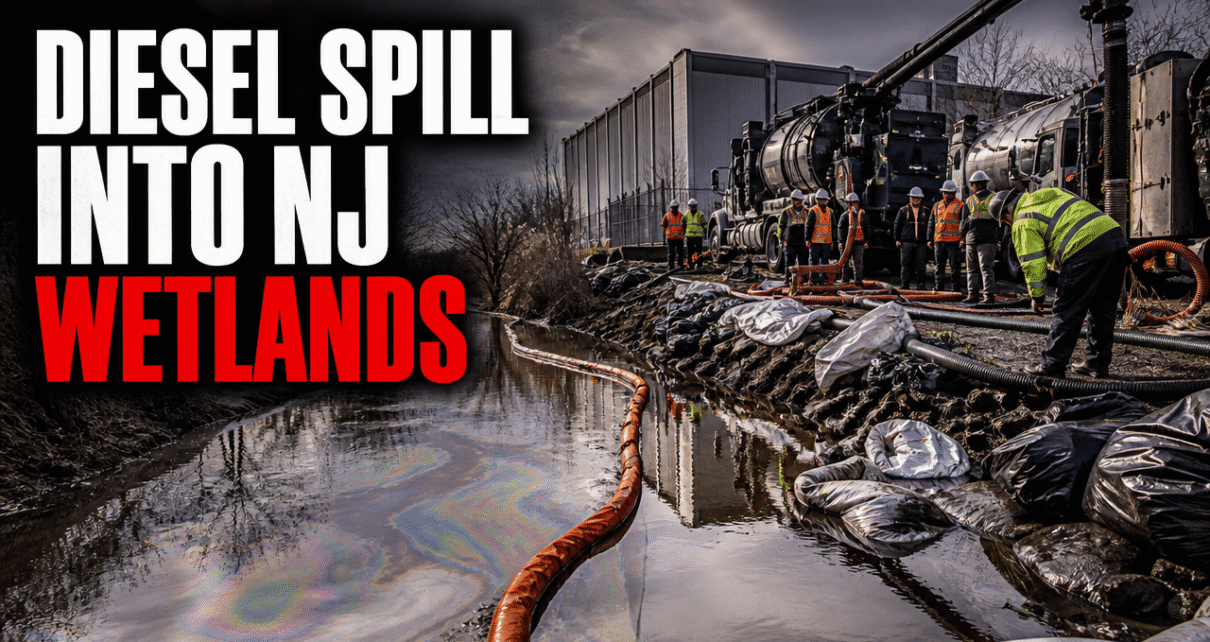
Over 5,000 gallons of diesel spilled from a New Jersey data center into a local creek, reigniting calls for a statewide pause on new data-center construction.
On September 11, 2026, an estimated 5,000 gallons of diesel were released from a storage tank at Equinix’s data-center facility on Hartz Way in Secaucus, New Jersey. Local reports put the total closer to 5,500 gallons. The fuel entered Anderson Creek, a tributary connected to the Hackensack River and part of the Meadowlands ecosystem.
Local officials and environmental representatives said they were told the incident involved a computer or software problem that continued calling for fuel even though the tank was full. However, the New Jersey Department of Environmental Protection said it has not yet determined the specific cause of the discharge. Equinix said it is investigating the root cause.
Cleanup crews installed protective booms and began removing contaminated water and fuel from the creek. NJDEP and the U.S. Coast Guard reported that they had not observed impacts to the Hackensack River or wildlife, and there are no drinking-water intakes in the area. Environmental advocates have cautioned that it is still too early to know whether there will be longer-term ecological effects.
The spill has also intensified New Jersey’s growing debate over data-center development. Ben Dziobek of the Climate Revolution Action Network renewed the group’s call for a statewide moratorium on new data centers, arguing that environmental risks can extend beyond individual municipal boundaries.
The incident does not by itself establish that data centers inevitably cause environmental disasters.
But it does highlight something often overlooked in the AI boom: behind the servers are massive physical facilities, backup generators, fuel systems, electricity infrastructure and other equipment that can create environmental risks when something goes wrong.
As AI infrastructure expands, communities are increasingly asking how these facilities can be built while protecting the land, water and people around them.
See less




 English