
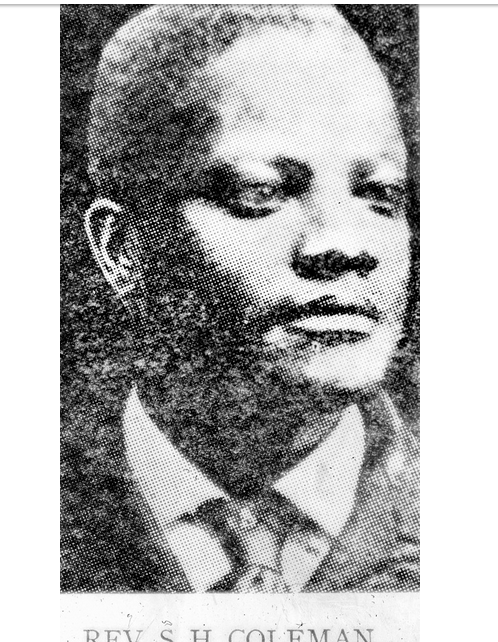

Singleton H. Coleman was an African American clergyman and politician who represented Marion County in the Florida House of Representatives during the Reconstruction era, serving from 1873 to 1874.[1][2] As a reverend affiliated with the African Methodist Episcopal Church, he contributed to early post-Civil War community leadership among freedmen in Florida, including involvement in church organization efforts in the Jacksonville District.[1] His legislative tenure occurred amid a brief period of black political participation enabled by federal Reconstruction policies, before the redeemer governments curtailed such representation through disenfranchisement measures.[2] Coleman is noted in historical records primarily for these roles, with a circa 1870 portrait preserved in state archives highlighting his clerical status.[1]
Early life
Birth and family background
Specific details of Singleton H. Coleman’s birth date, place of origin, and family lineage remain undocumented in accessible historical records.[1] This scarcity of personal biographical data is typical for many African American figures of the period, owing to inconsistent record-keeping under slavery and early freedom.
Education and early influences
No specific details on Coleman’s formal education or early influences prior to his clerical roles are available in historical records.
Religious career
Involvement with the African Methodist Episcopal Church
Singleton H. Coleman was ordained as a reverend in the African Methodist Episcopal (AME) Church, a denomination that expanded rapidly in Florida following the Civil War as formerly enslaved individuals sought independent religious institutions. He primarily ministered in Marion County, where he contributed to the establishment and growth of AME congregations amid the social upheavals of Reconstruction.[1][3] In his clerical capacity, Coleman advanced to the role of Presiding Elder, a supervisory position overseeing multiple churches within a district. As Presiding Elder, he organized revival meetings and traditional gatherings to bolster community faith and AME organizational strength, such as a notable event described as a “good, old-fashioned” assembly shortly after key denominational developments in the state.[4] He also participated in AME district activities, including representation for the Jacksonville District alongside figures like William Cole, aiding in the church’s administrative and evangelistic efforts during the 1870s.[4] Coleman’s ministerial work intertwined with broader African American community leadership, providing a platform for education, moral guidance, and political mobilization in Marion County, though specific pastoral assignments beyond his elder oversight remain sparsely documented in primary records. His AME affiliation underscored the church’s pivotal function as a hub for freedmen’s autonomy and resistance to white supremacist backlash in postwar Florida.[1][4]
Ministerial roles in Florida
Singleton H. Coleman served as a minister in the African Methodist Episcopal (AME) Church primarily in central and northeast Florida, beginning in Marion County where he was active as a reverend during the post-Civil War era.[1] His ministerial efforts focused on church establishment and expansion amid the growth of Black congregations following emancipation.[4] Coleman was ordained as a deacon on December 20, 1873, during the Eighth Annual Session of the Florida Conference in Gainesville, marking his formal entry into clerical leadership.[4] Earlier that year, in May 1873, he joined a fundraising team appointed by Bishop Thomas M. D. Ward to support Brown Chapel AME Church’s university initiative in the Jacksonville District, alongside ministers John R. Scott Sr. and William Cole.[4] By 1882, Coleman had emerged as a key church builder, constructing a 24-by-40-foot chapel in Sanford—described as the finest in the town—and completing Mount Olive AME Church in Orlando by October of that year.[4] He continued this work in 1885, erecting a new sanctuary frame in Orlando that was fully paid for by August, succeeding Bishop Abram Grant as the foremost architect of AME infrastructure in Florida.[4] Throughout the 1880s and 1890s, Coleman participated actively in the Florida and East Florida Conferences, attending sessions in locations including Pensacola and contributing to organizational efforts such as dividing the St. Johns River mission into four districts in 1883 to facilitate ministerial deployment.[4] In July 1893, as presiding elder, he organized a camp meeting in Sweetwater, south of Jacksonville, to bolster spiritual outreach.[4] His later roles included serving as a trustee for Edward Waters College in Jacksonville, where on May 23, 1891, he helped approve its renaming from Florida Normal and Divinity High School, underscoring his commitment to educational institutions tied to the AME.[4] These activities positioned Coleman as a pivotal figure in the AME’s institutional solidification in Florida during Reconstruction and beyond.[4]
Political career
Context of Reconstruction-era politics in Florida
The Reconstruction era in Florida, spanning roughly 1865 to 1877, followed the state’s Confederate defeat and aimed to rebuild its political and social order under federal oversight. Initially, under President Andrew Johnson’s lenient plan, provisional Governor William Marvin convened a constitutional convention in 1865 that largely restored white Democratic control and excluded African Americans from voting, prompting Congress to reject it and impose military rule via the Reconstruction Acts of 1867.[5] These acts divided the South into military districts, requiring Florida to draft a new constitution ratifying the Fourteenth Amendment, abolishing slavery, and enfranchising black males; the resulting 1868 constitution was ratified by voters, enabling the state’s readmission to the Union on June 25, 1868.[6] Republican dominance emerged through coalitions of freedmen, Northern migrants (carpetbaggers), and Southern Unionists (scalawags), electing Governor Harrison Reed in 1868 and securing legislative majorities that advanced public education, infrastructure, and civil rights for African Americans. Black voters, comprising a significant portion of the electorate due to universal male suffrage, propelled unprecedented representation: the 1868 legislature included about 20 African American House members, and similar numbers served in subsequent sessions, including in 1873 when figures like Singleton Coleman from Marion County held seats. Yet Republican administrations grappled with internal divisions, fiscal mismanagement—such as debts from railroad subsidies—and impeachment attempts against Reed in 1872 over alleged corruption, which Democrats exploited to portray the era as chaotic.[7][2] Opposition from conservative Democrats, who regained influence through paramilitary groups like the Ku Klux Klan, involved widespread voter intimidation, election fraud, and violence targeting black Republicans, eroding federal enforcement after the early 1870s pullback under Presidents Grant and Hayes. By 1874, Democrats had captured the governorship with Marcellus Stearns’s disputed succession yielding to their pressure, but the decisive shift came in the 1876 elections, where Redeemer George F. Drew prevailed amid contested returns, aligning with the national Compromise of 1877 that withdrew federal troops and restored white supremacist “home rule.” This transition dismantled Republican gains, paving the way for disenfranchisement and segregationist policies formalized in Florida’s 1885 constitution.[6][8]
Election and service in the Florida House of Representatives
Singleton H. Coleman, a Republican minister, was elected to represent Marion County in the Florida House of Representatives in the November 1872 general election, during a period when enfranchised African Americans formed a voting majority in the county, comprising 65% of registered voters.[3] This election reflected broader Reconstruction dynamics in Florida, where federal enforcement of the Fourteenth and Fifteenth Amendments enabled black political participation following the 1868 state constitution, allowing former slaves to vote and hold office despite opposition from former Confederates.[2] Coleman took office for the 1873 legislative session and continued serving into 1874 as one of seven African American representatives from Marion County by the end of Reconstruction.[3] His tenure occurred amid Republican control of the state government, which prioritized public education and civil rights measures, though specific bills sponsored by Coleman are not prominently documented in available records.[2]
Key legislative activities and positions
Singleton H. Coleman served as a representative from Marion County in the Florida House of Representatives during the 1873 and 1874 legislative sessions, amid the Republican-dominated Reconstruction government.[2] As an African American Republican and African Methodist Episcopal minister, his positions aligned with the party’s agenda to extend civil rights, establish public institutions for freedmen, and counter Democratic opposition to federal Reconstruction policies.[4] [3] Detailed records of individual bills sponsored or specific votes cast by Coleman remain scarce in accessible historical documents, a common limitation for many black legislators of the era due to incomplete archival preservation and focus on collective Republican efforts.[2] Nonetheless, he contributed to a legislative environment where African American members, including contemporaries like Tom Long, advanced measures for free public education systems mandated by the 1868 Florida Constitution, funding schools accessible to both races for the first time.[3] These efforts reflected broader Republican commitments to literacy and economic uplift for former slaves, though implementation faced resistance and funding shortfalls from white taxpayers.[2] Coleman’s ministerial background likely informed advocacy for moral and educational reforms, consistent with AME Church leaders’ involvement in politics to secure black enfranchisement and community development.[4]
Later life
Post-political activities
Following his tenure in the Florida House of Representatives, which concluded in 1874, Singleton Coleman continued his clerical duties with the African Methodist Episcopal (AME) Church, including in Marion County. Coleman contributed to church development in Florida, assuming leadership in building and expanding AME congregations, such as constructing a chapel in Sanford and completing Mt. Olive in Orlando by 1882, and overseeing a new sanctuary in Orlando by 1885. He also led revivals, including one in Maitland in 1883, served as a trustee for Edward Waters College in 1891, and organized a camp meeting near Jacksonville in 1893. These endeavors underscored his commitment to religious organization and community upliftment in the post-Reconstruction context.[4]
Family and personal contributions
Historical records provide limited details on Singleton Coleman’s family life. As a prominent figure in the African Methodist Episcopal Church and Florida politics during Reconstruction, Coleman’s personal commitments appear to have centered on community leadership and religious service, though specific information about his spouse, children, or familial roles is not documented in available primary or secondary sources from the era.[1][3] His contributions to personal and family spheres likely aligned with broader efforts to uplift freedmen families through education and moral guidance via the church, but verifiable personal anecdotes or family genealogy remain elusive.[4]
Death and legacy
Death and burial
Singleton H. Coleman died on October 11, 1874.[9] The cause and circumstances of his death are not detailed in available records from the period. No primary sources detail his burial location, which is consistent with the limited surviving documentation on post-Reconstruction-era African American clergy and politicians in rural Florida counties like Marion.
Historical assessment and controversies
Singleton H. Coleman, an African American clergyman, served as a state representative from Marion County in the Florida House during the Reconstruction period, specifically in 1873 and 1874, contributing to early efforts in black political representation amid post-Civil War reforms.[2] Local historical accounts portray him positively as part of a cohort of black legislators who advanced public education and community interests, such as through bills establishing free schools, though specific legislative actions attributed directly to Coleman remain undocumented in primary records. His inclusion in Ocala’s Black History Mural underscores a regional recognition of his role in pioneering African American participation in Florida governance during an era of expanded suffrage for freedmen. No personal scandals or corruption charges against Coleman appear in contemporary or historical records, distinguishing him from some Reconstruction-era figures accused of graft. However, his tenure occurred within the broader controversies of Florida’s Reconstruction politics, where Democratic opponents systematically alleged incompetence, fiscal mismanagement, and electoral irregularities in Republican-led assemblies dominated by newly enfranchised blacks and Northern transplants. These critiques, often propagated through partisan newspapers and later Lost Cause historiography, contributed to the violent overthrow of Reconstruction governments by 1876, framing black legislators like Coleman as symbols of imposed federal overreach rather than legitimate representatives. Empirical reviews of legislative outputs, including expanded public schooling and civil rights measures, counter claims of universal ineptitude, though elevated taxes and sporadic corruption cases fueled white backlash. Modern assessments, influenced by progressive academic narratives, tend to rehabilitate these figures’ legacies while underemphasizing fiscal strains and local resistance documented in period accounts.[2][1]

 English