<ins class='dcmads' style='display:inline-block;width:728px;height:90px'
data-dcm-placement='N46002.3910832MAHOGANYREVUE/B29181624.356591058'
data-dcm-rendering-mode='iframe'
data-dcm-https-only
data-dcm-gdpr-applies='gdpr=${GDPR}'
data-dcm-gdpr-consent='gdpr_consent=${GDPR_CONSENT_755}'
data-dcm-addtl-consent='addtl_consent=${ADDTL_CONSENT}'
data-dcm-ltd='false'
data-dcm-resettable-device-id=''
data-dcm-app-id=''>
<script src='https://www.googletagservices.com/dcm/dcmads.js'></script>
</ins>
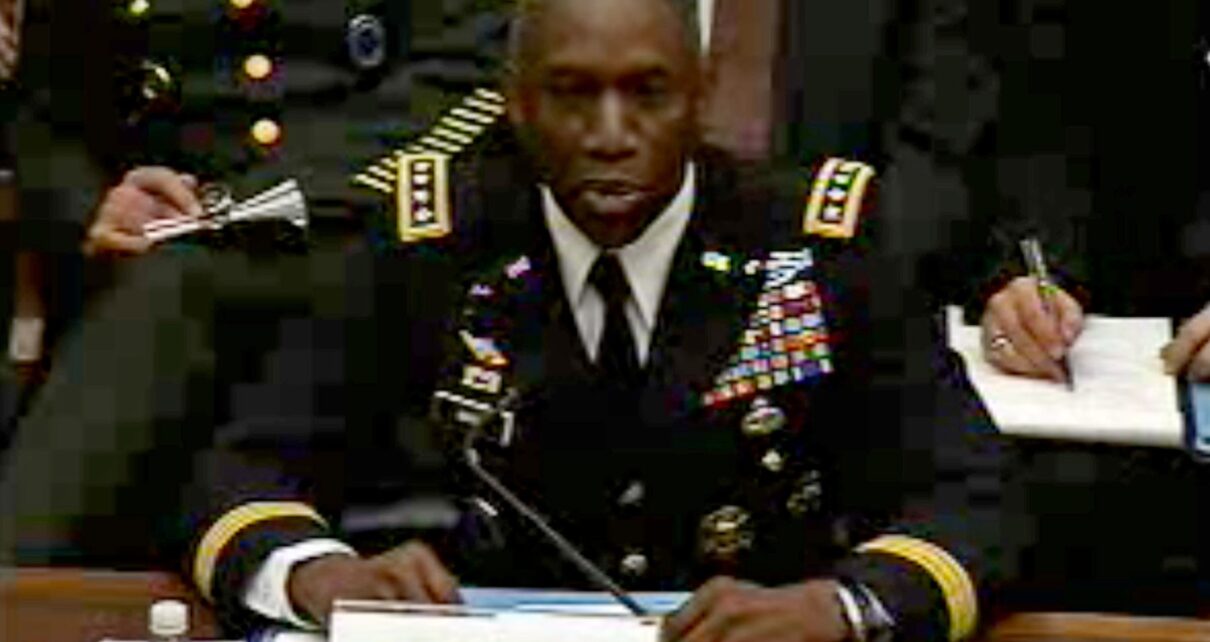
General William E. “Kip” Ward is not commonly recognized by the moniker “the general who answered a joke,” but he is historically significant as the first commander of U.S. Africa Command (AFRICOM) and one of the few four-star Army generals to be demoted upon retirement in modern history.
Key Details About Gen. William “Kip” Ward:
- The “Joke” Reference: While there is no widely documented anecdote of him literally answering a joke, he is recognized for an early career moment in 1971. As a young cadet in uniform visiting his father, he was greeted with the playful, prophetic phrase, “Hello, General!”. This “joke” or comment came true when he was promoted to four-star general in 2006.
- Historic Command: Ward was the first commander of AFRICOM (2007-2011), making him the fifth African American to achieve the rank of four-star general in U.S. Army history.
- Demotion and Controversy: Following an investigation by the Department of Defense Inspector General, it was found that Ward had engaged in lavish, unauthorized spending, including using military aircraft for personal travel, having his wife travel on official trips, and directing staff to run personal errands.
- Final Rank and Retirement: In 2012, Defense Secretary Leon Panetta demoted Gen. Ward to the rank of Lieutenant General (3-star) upon his retirement and ordered him to reimburse the government $82,000
The General Who Answered a Joke: Lieutenant General William E. “Kip” Ward
In 1971, a young Black man came home from college for Christmas break. He was wearing a new Army ROTC uniform — no rank, no ribbons, just the standard-issue jacket. His father, a World War II veteran who had fought for a country that didn’t fully respect him, looked his son up and down and said, “Hello, General!”
It was a joke. A dream. A hope from a man who had seen too many doors slammed shut. Thirty-six years later, that young man walked into the Pentagon as a four-star general — and then did something no African American officer had ever done. He took command of an entire continent.
This is the story of William E. “Kip” Ward — the first commander of U.S. Africa Command, the first African American to lead a unified combatant command, and a man who spent four decades proving that a father’s joke could become history.
The Boy Named “Kip”
William Eaton Ward was born on June 3, 1949, in Baltimore, Maryland, to Richard Isiah Ward and Phyllis Mary Ward. His nickname came from his mother’s youngest sister, who one day started calling him “Kip” for no particular reason. The name stuck, following him through childhood, college, and into the highest ranks of the United States military.
He grew up in a Baltimore neighborhood where the Army was a real option for a Black man with ambition — but not necessarily a path to the top. His father had served in World War II, a combat veteran who understood both the honor of military service and the sting of fighting for a country that treated him as less than equal.
When Kip enrolled at Morgan State University, a historically Black university in Baltimore, he planned to study political science and eventually become a lawyer. The Army was just a detour. “When I graduated, I planned on going through the Army to serve my four years, come out and then go to law school and become a lawyer,” he later said.
He joined the ROTC because it was mandatory for two years — and then he stayed. In 1971, he graduated as a Distinguished Military Graduate and was commissioned as an infantry second lieutenant.
The Detour That Became a Career
His first assignment was as a rifle platoon leader with the 82nd Airborne Division at Fort Bragg, North Carolina. Then came South Korea. He found himself commanding an infantry company with more than 100 soldiers under his command — and he was loving it. “When I reached my four-year mark, I found myself commanding an infantry company in South Korea, with more than 100 incredibly talented and diverse young men, and I was really enjoying it.”
Law school could wait. Ward was hooked.
By 1979, he had earned a master’s degree in political science from Pennsylvania State University. Then came an assignment that would shape his understanding of international relations: he spent three years as an assistant professor of political science and public policy at the United States Military Academy at West Point. He wasn’t just learning strategy — he was teaching it to the next generation of Army leaders.
The Global Soldier
Over the next two decades, Ward’s career took him to some of the most dangerous and diplomatically sensitive places on Earth. He served in Egypt as chief of the Office of Military Cooperation at the U.S. Embassy. He commanded the 2nd Brigade of the 10th Mountain Division during Operation Restore Hope in Mogadishu, Somalia — a mission that turned into one of the most complex urban warfare situations of the 1990s.
He served as commander of the Stabilization Force during Operation Joint Forge in Sarajevo, Bosnia, helping to enforce the fragile peace after the Balkan Wars. He was deputy director of operations for the National Military Command Center, the Pentagon’s nerve center for global crises.
By 2005, he was Deputy Commanding General and Chief of Staff of U.S. Army Europe and the Seventh Army in Germany. That position put him on the radar of Secretary of State Condoleezza Rice, who selected him to serve as the U.S. Security Coordinator for the Israel-Palestinian Authority. For nine months, he mediated between two sides that had been at war for generations — a job that required more diplomacy than firepower.
The Father’s Joke Comes True
On May 26, 2006, William “Kip” Ward was promoted to four-star general. He became only the fifth African American to achieve that rank in the history of the United States Army.
The boy who had walked into his father’s house wearing a cadet uniform and heard “Hello, General!” had become exactly that.
But his greatest challenge was still ahead.
On October 1, 2007, Ward became the first commander of a brand-new unified combatant command: United States Africa Command, or AFRICOM. For the first time, the U.S. military had a single command dedicated entirely to the African continent. Previously, Africa had been divided between three separate commands — European Command, Central Command, and Pacific Command — each with its own priorities and none with Africa as its primary focus.
Ward was given the task of building this command from the ground up. He was the architect, the diplomat, and the face of America’s new approach to African security.
The Quiet Revolution
Ward did not see AFRICOM as an instrument of military domination. He saw it as a platform for partnership. “We’re not here to impose solutions,” he often said. “We’re here to work with our African partners to support their own goals for peace and stability.”
Under his leadership, AFRICOM emphasized capacity-building over combat operations. Ward prioritized non-commissioned officer development programs, military intelligence training, and maritime security enhancements — all designed to strengthen indigenous security institutions rather than replace them.
He also understood something that many military leaders missed: security could not be disentangled from development, governance, and human rights. “The health of Africa’s security infrastructure is tied to the health of its governments and economies,” he once remarked.
He didn’t just talk. He visited villages in Djibouti. He met with the Malaria Consortium in Uganda to discuss providing insecticide-treated bed nets to pregnant women and children. He showed up in places where generals rarely went, and he listened.
His vision was simple: “Years from now we want Africans and Americans to be able to say Africom made a difference — a positive difference.”
The Fall
For all his accomplishments, Ward’s career ended in controversy.
In 2012, an investigation by the Department of Defense Inspector General found that Ward had engaged in “unauthorized spending of government money for himself, his wife, and staff members.” The report alleged that he had used military vehicles for his wife’s shopping trips, accepted a payment from a government contractor, charged the government for lengthy stays at fancy hotels, and used a five-vehicle motorcade to transport himself and his staff to Washington, D.C.
The allegations were serious. Secretary of Defense Leon Panetta ordered Ward to be demoted from four-star general to lieutenant general — a rare and humiliating punishment for a man of his rank. Ward retired soon after.
The fall was swift and painful. A man who had spent 40 years building an impeccable career saw his final chapter written in inspector general reports. But those who served with him remembered the work he had done, not the mistakes at the end.
The Life After
After retiring from the Army, Ward became President and Chief Operating Officer of Sentel Corporation, an engineering company that provides technical services to the U.S. government. He and his wife, Joyce, settled in Reston, Virginia.
His military honors remain formidable: the Defense Distinguished Service Medal with two oak leaf clusters, the Distinguished Service Medal with oak leaf cluster, the Defense Superior Service Medal with two oak leaf clusters, the Legion of Merit with three oak leaf clusters, the Combat Infantryman’s Badge, and the Master Parachutist Badge.
He holds honorary doctorates from Morgan State University and Virginia State University. He is a member of Omega Psi Phi Fraternity, Inc., and the 100 Black Men of America.
What Kip Ward Knew
William “Kip” Ward understood something that his father, the World War II veteran, had tried to tell him all those years ago: that a Black man could rise to the highest levels of American military leadership if given the chance. His father had fought in a segregated Army. Ward commanded a unified combatant command.
He also understood that partnership matters more than power. In Africa, he did not try to impose American solutions. He asked African leaders what they needed and helped them build it themselves. His AFRICOM was not about bases or bombs. It was about training, development, and respect.
“I am proud of our role as a military in fulfilling the American dream that all Americans, regardless of their ethnic background, have a fair opportunity to serve their nation,” he once said.
The father who joked “Hello, General” never lived to see his son pin on four stars. But the son carried that joke with him from Baltimore to Korea, from Somalia to Stuttgart, from a cadet uniform to the command of a continent.
He was the first African American to lead a unified combatant command. He built AFRICOM from nothing. He opened doors that had never been opened before.
And when it was over, he went home — a general who had answered a joke with a lifetime of service.




 English