
******************************************************************************************
******************************************************************************************
SUMMARY’
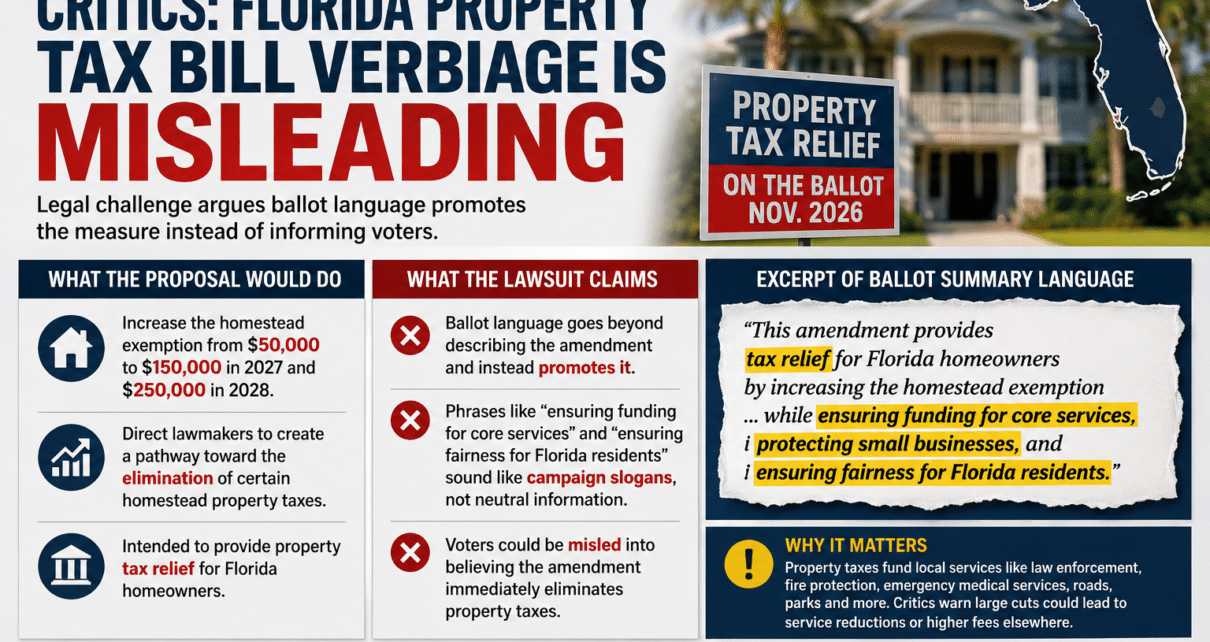
This November, Florida voters will decide a ballot question that, if approved, would gut their city’s or county’s ability to fund core services like libraries, parks and law enforcement. Amendment 3 seeks to raise the homestead exemption for property taxes (excluding schools) to $150,000 in 2027 and $250,000 in 2028 while restricting what local governments can spend property tax dollars on, creating a path to eliminate non-school property taxes entirely.
State economists project a revenue loss of roughly $5 billion in the first year, growing toward $12 billion a year within five years.
Here are five reasons every Florida resident should oppose this ill-advised proposal:
1. It would be a cost shift, not a cost reduction.
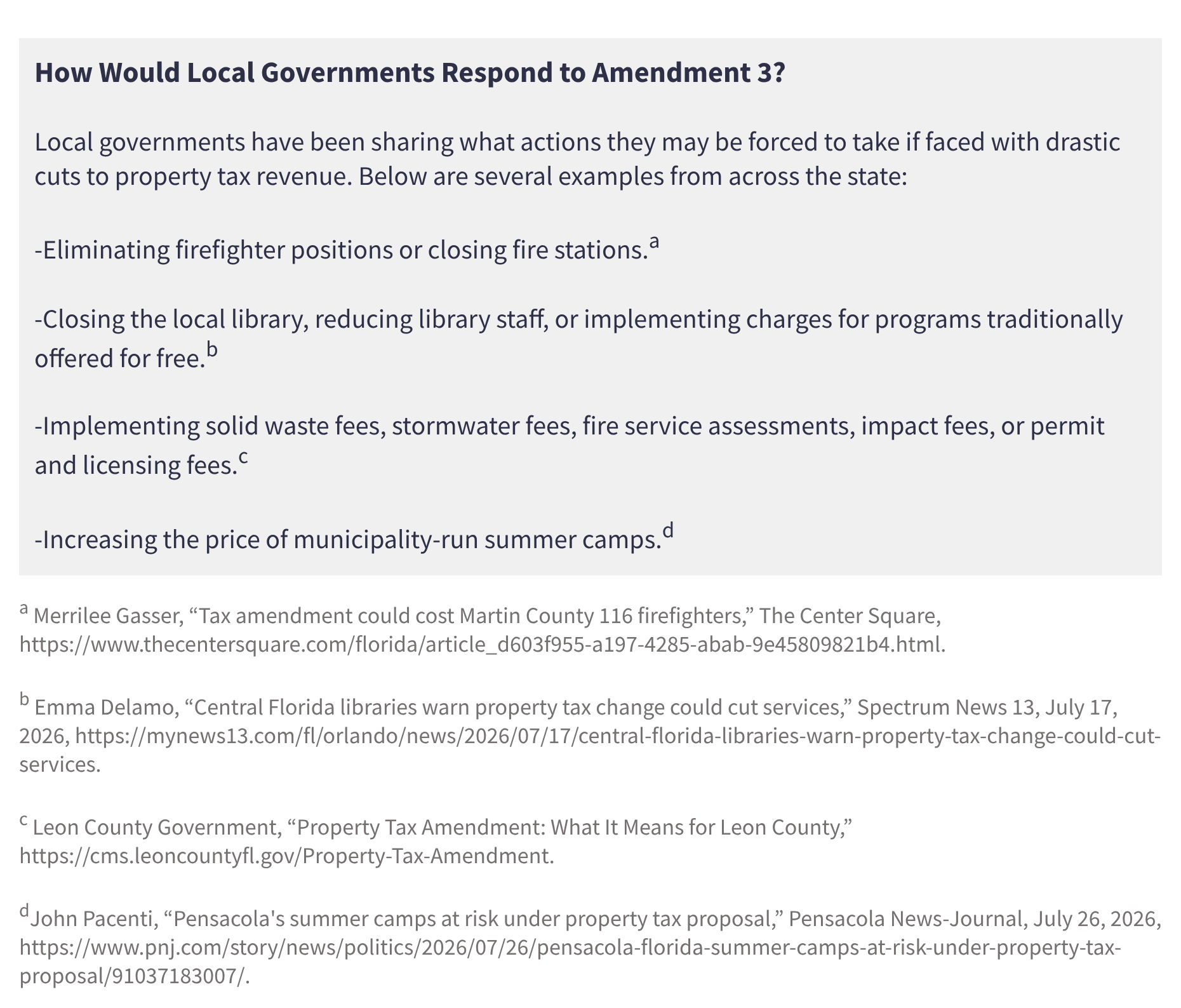
Firefighters, police officers and emergency medical technicians still need to get paid. Parks still need maintenance. Libraries still need librarians and computers for people who do not have broadband at home. Shutting off such a large part of the local government revenue stream would force local lawmakers to cut these and other vital programs — or make up the difference with new fees and higher tax rates on everything still taxable. The direction your local officials take would likely depend on where you live. Counties with a big commercial base can decide to shift the revenue burden onto businesses and renters. Counties that rely significantly on taxes from homeowners would be more likely to make cuts.
2. Renters would get no break and would likely pay more.
About a third of Florida households rent their homes. Renters do not qualify for a tax exemption on a home they do not own. When a city raises its millage rate (how the amount of property taxes owed is determined) to cover the shortfall, renters would likely pay higher rents with no exemption to offset it. Nothing would require a landlord to eat the difference. One Leon County judge who reviewed the ballot language agreed.
3. Unprotected services would take the hit.
Amendment 3 would write seven categories of local spending into the Florida Constitution: public safety, education and schools, infrastructure, natural resources, bond debt service, employee retirement and government operations. But libraries, public transportation, parks and recreation, childcare and affordable housing aren’t on the list. Those services would compete for whatever funding would be left over — and there would be much less left over. Miami-Dade County’s proposed budget already cuts a dozen bus routes with county officials citing preparation for Amendment 3 as one reason.
4. City and county workers would likely lose their jobs.
Cuts this size do not stay on paper. They result in permanent job cuts. Imagine your city with no one to run the library, staff the emergency shelter or maintain the neighborhood parks. Public safety is not immune either. The Fraternal Order of Police, Florida Professional Firefighters and the Fire Chiefs Association have all come out against Amendment 3.
5. It would gift more power to the Legislature.
Amendment 3 would order the Legislature to write a uniform procedure that counties and cities would have to follow. It would lock a state-approved spending list into the constitution, eroding home rule. With local governments unable to raise revenue to meet the needs of their constituents, Tallahassee would decide which communities get appropriations. That is an open invitation to favoritism, likely resulting in fewer resources for Black and Brown communities.
The bottom line is that while Amendment 3 may sound good on paper, it would force every local government to cut its revenue — whether people living in that community want to or not. It would only hurt programs that many Florida families rely on.
Remember: The amendment needs 60% of the vote to pass.
Tell your friends and family that we need to save our services. A “no” vote on Amendment 3 would help do that.
THE “NO” IS ENDORSED BY FRANKIE L. BROWN, OWNER OF BROWN MEMORIAL FUNERAL HOME & CREMATION SERVICES, OF OCALA FLORIDA
Voter Guide: What Floridians Should Know About Amendment 3

This guide was originally published on Aug. 7, 2026. On Aug. 13, the state of Florida provided updated ballot language on Amendment 3, as a circuit judge had required. FPI updated the guide on the publication date above to reflect the new language.
Amendment 3 is on the Florida ballot in 2026. The amendment would increase the exemption on homesteads, create a pathway for the full elimination of non-school property taxes on homesteads, and reduce the assessment growth cap on non-homesteaded properties.
1. If Amendment 3 passes, local governments face deep cuts to revenue. Florida families would see cuts to services, increased taxes and fees, or a combination of both.
Under Amendment 3, Florida counties, cities, towns, villages, and special taxing districts —which include public hospitals, children’s services councils, water management districts, and more — would see a significant reduction in property tax dollars that currently go toward public services. State economists predict that Amendment 3 would reduce local revenue by nearly $12 billion on a recurring basis.[1] (See Figures 1 and 2.) As a result, local governments would have to decide whether to cut funding for these services or raise revenue by other means.
2. The loss of property tax dollars under Amendment 3 would ultimately shift costs onto renters, consumers, and small businesses as local governments look to generate revenue.
According to the Tax Foundation, if voters approve Amendment 3, “[e]liminating such a sizeable share of Florida’s property tax base would not reduce the cost of providing local government services; it would simply require that the lost revenue be generated elsewhere, including from higher millage rates on all property that remains taxable.”[2] In other words, Amendment 3 would lead to a cost shift as localities turn to non-homesteaded properties like rental units or commercial properties to raise property taxes.
If property taxes increase for commercial properties, all businesses end up paying more, and they would have to decide whether to absorb those costs or shift them onto renters and consumers.
3. A court ordered Florida’s attorney general to rewrite the ballot language for Amendment 3.
Florida’s Circuit Court of the Second Judicial Circuit in and for Leon County ruled that the original ballot title read like a “political slogan” that “endorses” the amendment while “divert[ing] voters from its actual effect.”[3] The court also found the ballot summary lacking, stating that “the present ballot language would deprive the voters of the opportunity to make a meaningful decision.” Since the court found the original language “defective,” Florida’s attorney general had to revise the statement. As a result, the attorney general rewrote the title and summary to reflect the court’s suggestions.
Notes
[1] Office of Economic and Demographic Research analysis of HJR 1-F, June 12, 2026, https://edr.state.fl.us/content/conferences/revenueimpact/archives/2026F/_pdf/impact0612.pdf.
[2] Nicole Fox and Katherine Loughead, June 3, 2026, “The Real November Ballot Question: What Price Are Floridians Willing to Pay to ‘Save Their Homes?’” Tax Foundation, https://taxfoundation.org/blog/florida-property-tax-proposal/.
[3] Save Our Voters from Misleading Ballot Language et. al. v. Cord Byrd et. al., No. 2026 CA 1254 (Fla. 2d Cir. Ct. Aug. 3, 2026) (final order granting summary judgment).
***************************************************
Florida Amendment 3 Explained: Why Voters Should Oppose the Property Tax Amendment
Florida voters will decide this November whether to approve Amendment 3, a sweeping change to the way local property taxes work.
The proposal would increase the homestead exemption for non-school property taxes, reduce the annual assessment-growth cap on non-homestead properties from 10% to 5%, and create a pathway toward further eliminating property taxes on homesteaded properties.
For homeowners struggling with the rising cost of living, a property tax cut may sound appealing. But Amendment 3 does not eliminate the cost of running our communities. It changes how those costs are paid, potentially leaving counties and cities with three choices: cut services, raise other taxes and fees, or shift more of the burden onto renters and businesses.
Florida Amendment 3 Explained
For Miami-Dade, where affordability is already pushing residents out and local governments face enormous infrastructure and service needs, the consequences could be particularly significant.

1. Homeowners may pay less in taxes, but communities could lose services
Property taxes fund many of the services residents rely on every day.
Schools are specifically excluded from Amendment 3, meaning the amendment does not reduce the school district property-tax base. But county, municipal and special-district property taxes would be affected.
Those revenues help support services including fire and rescue, parks, libraries, infrastructure, environmental protection, flood mitigation and programs for children and families.
State economists have estimated that Amendment 3 could reduce local property-tax revenue statewide by approximately $5 billion in its first year and nearly $11.8 billion annually after five years.
For Miami-Dade alone, a Florida Policy Institute analysis estimates that the county government could lose approximately $214 million in operating revenue in the first fiscal year and $388 million the following year, before including losses to municipalities and separate taxing districts.
Those are projections from an organization opposing the amendment, not official Miami-Dade County estimates. But they illustrate the scale of the choices local governments could face.
Miami-Dade is already confronting significant fiscal pressures. Its proposed budget identifies approximately $53 million in unmet operating needs and more than $22 billion in unfunded capital projects.
Reducing a major source of recurring revenue could make those choices even harder.
What could be affected in Miami-Dade?
Some of the most tangible examples include:
Fire and emergency services. Miami-Dade Fire Rescue relies in part on property taxes through its fire district. Public safety remains an allowable use of property-tax revenue under Amendment 3, but that does not guarantee existing funding levels if the overall tax base shrinks.
Parks and libraries. Miami-Dade’s parks and libraries are core quality-of-life services supported by local revenue. The Library District alone expects roughly $129 million in ad valorem revenue in the current budget year.
Programs for children and families. The Children’s Trust, which funds early learning, after-school programs, developmental services and other support for children and families, receives revenue from its own property-tax millage. Florida Policy Institute estimates Amendment 3 could reduce Trust revenue by tens of millions of dollars annually.
Flood protection, resilience and environmental projects. Miami-Dade faces unusually large costs associated with flooding, sea-level rise, stormwater systems, water infrastructure and protection of natural resources. These are among the uses permitted under the amendment, but they would still compete for a potentially smaller pool of local revenue.
Transportation and infrastructure. Transit, roads and major infrastructure projects are financed through multiple revenue sources, so Amendment 3 would not simply remove a specific dollar amount from transit. But less flexible local revenue could make it harder for the county to supplement those programs or address new infrastructure needs.
Affordable housing. Many affordable-housing programs depend on federal, state or dedicated trust-fund revenue. Still, Miami-Dade also uses local resources to respond to its housing crisis. A tighter local budget could reduce flexibility to expand or supplement those efforts.
Even services funded mainly through fees can become part of the equation. Garbage collection, for example, is largely paid through a separate assessment rather than the ordinary property tax affected by Amendment 3.
That highlights a broader problem: cutting property taxes does not eliminate the cost of providing local services. Those costs can reappear as higher fees, assessments, fares or other taxes.
2. Renters could pay more without receiving the tax break
The potential effect on renters is one of the strongest arguments against Amendment 3.
Homesteaded homeowners would receive the expanded exemption. Renters would not.
Rental properties generally fall into the non-homestead category. If counties and cities respond to lost homestead revenue by increasing millage rates on the remaining tax base, landlords could face higher property-tax bills.
A September analysis commissioned by the Florida Housing Coalition, Florida Apartment Association, Miami Homes for All and Florida Policy Project examined that scenario.
If local governments replaced all of the lost revenue through property-tax rates, the analysis estimated that the average Florida apartment could face approximately $406 more in annual property taxes by 2028, increasing to $554 by 2031.
In Miami-Dade County, the modeled increase was approximately $291 per apartment unit in 2028.
That does not mean every Miami-Dade renter would automatically pay $291 more in rent. The analysis models one possible response by local governments rather than predicting exactly what every county and city will do.
Governments could instead cut spending, increase fees, raise other taxes or use some combination of those options.
But when taxes and operating costs on rental properties increase, landlords can pass at least some of those costs on to tenants over time.
That creates an uncomfortable contradiction: a constitutional amendment promoted as property-tax relief could provide the largest direct benefit to homeowners while leaving renters exposed to higher rents, fees or reduced public services.
And renters are already among the Miami-Dade residents most vulnerable to being priced out.
3. Tallahassee should not make Miami-Dade’s budget decisions
There is also a larger question of local control.
Florida is an extraordinarily diverse state. The needs of Miami-Dade County are not the same as the needs of a small rural county in North Florida.
Miami-Dade has nearly 2.8 million residents, a massive transportation system, two major economic gateways in PortMiami and Miami International Airport, enormous infrastructure requirements, and unique challenges involving hurricanes, flooding, sea-level rise and housing affordability.
Yet Amendment 3 would place a statewide constitutional framework around how local governments raise and use property-tax revenue.
Miami-Dade voters already elect a mayor and County Commission to make decisions about local taxes and services. Residents of Miami, Miami Beach, Homestead, Hialeah and other municipalities elect their own local governments to do the same.
Those elected officials can be held accountable when residents believe taxes are too high or money is being spent poorly.
A statewide constitutional amendment reduces that flexibility.
A community facing aging infrastructure, chronic traffic, rising seas and one of America’s most severe housing-affordability problems should have the ability to decide how to pay for those priorities.
What works for one Florida county will not necessarily work for Miami-Dade.
Miami-Dade is already losing residents
There is another reason Miami-Dade should be particularly cautious about policies that could make the region harder to live in.
People are already leaving.
Between July 2023 and July 2024, Miami-Dade experienced a net domestic migration loss of more than 67,000 residents, the largest loss among Florida counties. International migration more than offset those departures that year, allowing the county’s overall population to continue growing.
But that changed the following year.
Between July 2024 and July 2025, Miami-Dade’s population fell by more than 10,000 residents, according to Census Bureau estimates, making it one of the largest numerical county population declines in the country. More than 72,000 residents were lost through net domestic migration, while a sharp decline in international migration was no longer enough to compensate.
For years, people arriving from abroad helped offset the number of residents leaving Miami-Dade for other parts of Florida and the country. From 2020 through 2025, Miami-Dade gained hundreds of thousands of residents through international migration even as it lost residents domestically.
That safety valve is now weakening.
Recent federal immigration policies, including the termination of Temporary Protected Status for large numbers of Venezuelan and Haitian immigrants, have created uncertainty for thousands of South Florida families. At the same time, Florida and local police departments have dramatically expanded cooperation with federal immigration authorities through 287(g) agreements.
That has economic consequences as well as human ones.
South Florida businesses have already reported concerns about losing workers and customers. One large Venezuelan-founded restaurant company reported a 20% decline in customer demand following changes to Venezuelan TPS, while the Greater Miami Chamber of Commerce has surveyed its members about the effect changing immigration policies are having on their workforces and businesses.
When residents leave a community, they do not just take themselves with them.
They take their spending with them.
They buy fewer meals at neighborhood restaurants, make fewer purchases at local stores, hire fewer local service providers and contribute less to the economic activity that supports small businesses throughout Miami-Dade.
That makes the potential long-term consequences of Amendment 3 larger than a line on a property-tax bill.
If declining local revenue means reduced services, deteriorating infrastructure or higher costs shifted onto renters and residents through other mechanisms, Democrats argue that Amendment 3 could add yet another reason for working and middle-class families to conclude that Miami-Dade is simply becoming too difficult to afford.
The real question is who ultimately pays
Florida has a real affordability crisis.
Homeowners are struggling with property taxes, insurance and the overall cost of housing. Renters are struggling too.
But Amendment 3 addresses one part of that problem by removing revenue from local governments without removing the responsibilities those governments have.
Firefighters still have to respond to emergencies.
Roads and bridges still need to be maintained.
Parks and libraries still serve our communities.
Children still need after-school programs.
Flooding still needs to be addressed.
And Miami-Dade still needs to build the infrastructure and housing required for millions of people to live here.
Someone ultimately pays for those things.
The question Amendment 3 raises is whether shifting those costs away from homesteaded property owners and toward renters, businesses, fees, assessments or reduced services actually makes Florida more affordable.
We believe it does not.
For Miami-Dade, the stakes are especially high. We are already watching working families leave because they cannot afford to stay, while changes in national immigration policy threaten another source of residents, workers, entrepreneurs and customers that has long sustained our growth.
The goal should be to make Miami-Dade a place where more people can afford to build a life, raise a family and run a business.
Amendment 3 risks moving us in the opposite direction.
Sources
- Florida Senate — CS/HJR 1-F: Save Our Homes from Excessive Property Taxes
- Florida Policy Institute — Amendment 3: Florida Property Tax Amendment
- Florida Housing Coalition — New Analysis Estimates Amendment 3’s Potential Impact on Florida Renters
- Miami-Dade County — FY 2026-27 Proposed Budget Executive Summary
- Florida Phoenix — Florida Democratic Party Votes to Oppose Property Tax Amendment
- WESH 2 — Amendment 3 Study: Florida Renters Could See Higher Costs
- Miami New Times — More People Are Leaving Miami-Dade Than Any County in Florida



 English