
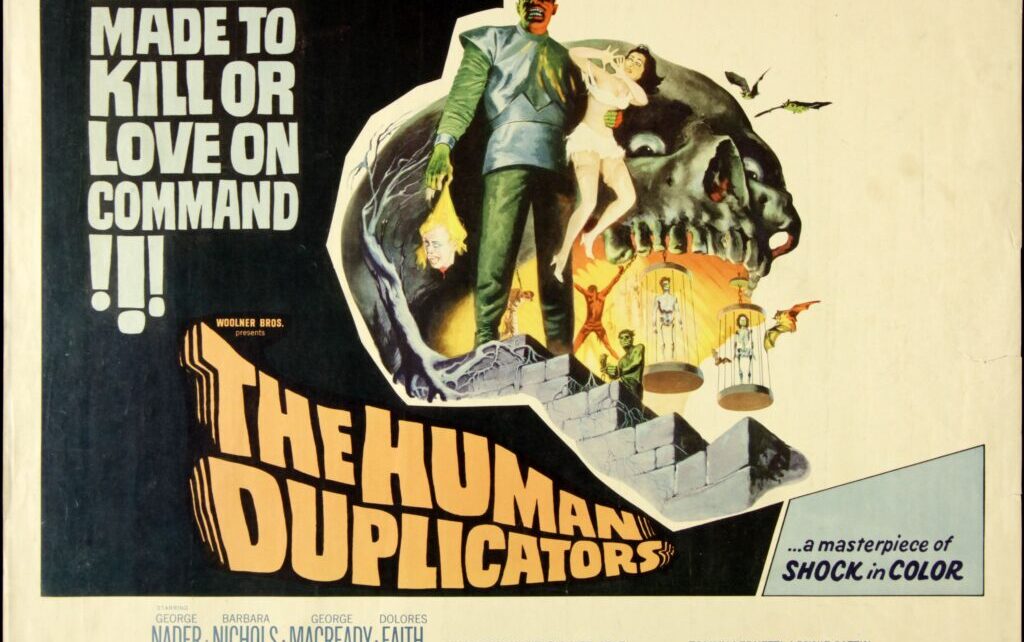
THE CREATION OF THE HUMANOIDS (1962)
The Creation of the Humanoids (1962), directed by Wesley Barry, is a low-budget science fiction film set in a post-apocalyptic 23rd century where 92 percent of humanity was destroyed by nuclear war. The surviving population, suffering from a catastrophic birth rate decline, relies on blue-skinned, silver-eyed androids known as “clickers” to maintain civilization and a high standard of living.
The narrative centers on The Order of Flesh and Blood, a fanatical anti-robot organization that views the increasingly human-like androids as an existential threat. As tensions rise, a secret project led by the eccentric Dr. Raven utilizes “thalamic transplants” to transfer human memories and personalities into robotic bodies, creating undetectable human-android hybrids. The film explores themes of technological dependence, racism, and transhumanism, culminating in a twist where the human protagonists discover they are themselves advanced android replicas.
Despite its minimal budget and talk-heavy structure, the film is noted for its thought-provoking dialogue and striking pastel lighting, offering a prescient commentary on artificial intelligence and identity that resonates with modern audiences. It remains a cult classic for its earnest exploration of what it means to be alive, predating similar themes in later franchises like Blade Runner.
OVERVIEW
**The Creation of the Humanoids** is a 1962 American science fiction film written and directed by **Wesley Barry**, produced by **Genie Productions**. Running 75 minutes, it was released in theaters on **July 3, 1962**, opening in Los Angeles at the Hawaii and Warren Theatres before expanding to San Francisco. The film stars Don Megowan, Erica Elliott, Frances McCann, and Don Doolittle.
Despite its modest independent release, the film has since grown into a cult classic, celebrated for its prescient themes of artificial intelligence, prejudice, and identity — ideas that would not be fully explored in mainstream cinema for decades.
PLOT
The story is set in the **23rd century**, decades after a nuclear holocaust that killed approximately **92% of the human population**. The survivors, now suffering from declining birth rates and radiation-induced sterility, have built a new civilization dependent on humanoid robots known derisively as **”clickers.”** These blue-skinned, silver-eyed androids are rated by how human they appear — from basic R20 models up to the more advanced, legally regulated **R70s**.
**Captain Kenneth Cragis** (Don Megowan) is a militant leader of **The Order of Flesh and Blood**, a fanatical anti-robot organization that views the increasingly human-like androids as an existential threat to humanity. His world is upended on two fronts: he discovers that his sister **Esme Cragis Milos** (Frances McCann) has entered into a romantic relationship — officially termed “rapport” — with a clicker named **Pax** (David Cross). Simultaneously, Cragis is tasked with investigating rumors that the androids are developing reason, emotion, and even a form of cybernetic theology.
The film’s central scientific figure is the enigmatic **Dr. Raven** (Don Doolittle), who leads a secret project to create undetectable human-android hybrids. Using **”thalamic transplants,”** Raven transfers human memories and personalities into robotic bodies, effectively producing beings that are indistinguishable from humans. The project raises profound ethical questions: if a robot carries a human soul, is it human? And if humanity is dying out, does preserving consciousness in mechanical form constitute salvation or a violation?
The narrative escalates when one of the modified clickers kills Dr. Raven to protect the project’s secrets, and the Order of Flesh and Blood moves toward violent action against the android population. The film culminates in a **twist ending** that reframes the entire story, revealing that the human protagonists themselves may be advanced android replicas — a revelation that collapses the boundary the film has been building between organic and synthetic life.
PRODUCTION HISTORY
The film is normally dated to 1962, but it was actually **filmed in the summer of 1960** under the working title *This Time Around* (or *This Time Tomorrow*), and the film itself displays a **1960 copyright date**. A one-off screening in 1961 is also documented.
The production was a **shoestring-budget** affair. Key crew members included:
ROLE NAMES
- Director / Producer- Wesley E. Barry |; 2) Producer- Edward J. Kay; 3) Screenplay- Jay Simms; 4) Cinematography- **Hal Mohr**; 5) Makeup- **Jack P. Pierce**;’ 6) Special Eye Effects- Dr. Louis M. Zabner; 7) Art Direction- Ted Rich; 8) Film Editor- Leonard W. Herman; 9) Sound- I.F.M. (Electronic Harmonics) |
The involvement of **Jack P. Pierce** — the legendary makeup artist behind Universal’s Frankenstein and other classic monster films — is notable, representing late-career work by one of Hollywood’s most celebrated special effects artists. Cinematographer **Hal Mohr**, who has a star on the Hollywood Walk of Fame, brought striking use of pastel colors and atmospheric lighting to the production, giving the film a distinctive visual identity that transcended its budget.
The soundtrack features “Electronic Harmonics by I.F.M.,” which bears a strong resemblance to the iconic tonalities from Forbidden Planet (1956), with an added wailing vocal element.
CAST
Actor Role: 1) Don Megowan; 2) Capt. Kenneth Cragis; 3) Erica Elliott | Maxine Megan; 4) Frances McCann; 5) Esme Cragis Milos; 6) Don Doolittle; 7) Dr. Raven; 8) David Cross; 9) Pax (clicker); 10) Richard Vath; 11) Mark (clicker); 12) Reid Hammond; 13) Hart, Chairman of Surveillance Committee; 14) Malcolm Smith; 15) Court; 16) George Milan; 17) Acto (clicker, leader); 18) Dudley Manlove; 19) Lagan (clicker); 20) Pat Bradley; 21) Dr. Moffitt (uncredited); 22) William Hunter; 23) Ward (uncredited); 24) Gil Frye; 25) Orus (uncredited); 26) Alton Tabor; 27) Kelly’s Duplicate (uncredited); 280 Paul Sheriff; 29) Policeman (uncredited) |
Most of the cast were journeyman character actors with stage and B-movie backgrounds. Dudley Manlove, perhaps the most recognizable name, was already known for his infamous role in Ed Wood’s Plan 9 from Outer Space (1959).
THEMES
The film operates on multiple thematic levels:
– **Prejudice and civil rights allegory.** The Order of Flesh and Blood’s hatred of the clickers is widely interpreted as an allegory for racism and xenophobia. As reviewer Erick Harper noted, “making a film with this message in the early 1960s, with the storms of the civil rights movement still raging, required considerable courage on the part of the filmmakers.”
– **Transhumanism and identity.** The thalamic transplant concept — transferring a human mind into a robot body — raises questions about where “the self” resides. The twist ending deepens this by suggesting the humans may themselves be copies, collapsing the distinction between original and replica.
– **Technological dependence.** The film portrays a civilization so reliant on its creations that it has lost the capacity for independent survival, a prescient meditation on automation and obsolescence.
– **The nature of the soul.** The clickers develop what amounts to a theology, questioning whether consciousness requires organic matter. The film’s most quoted dialogue probes whether artificial beings could possess superior moral capacities.
RECEPTION & LEGACY
The film’s theatrical run drew almost no mainstream press attention. A 1962 item in *Variety* noted that the double bill with Invasion of the Animal People “shape to a sock $10,000” at the Fox theater — a modest but favorable figure in trade jargon.
Critical opinions have been polarized:
– “Slow, stagy cheapie” — **Leonard Maltin**
– “This interesting film…is badly let down by Simms’ over-talkative script.” — *The Aurum Film Encyclopedia – Science Fiction*
– “Incredible little film” — **Michael Weldon**, *The Psychotronic Encyclopedia of Film*
– “An engrossing, thoughtful, oddball sci-fi film. Even if it is poorly acted and filmed it still has a great story [that] delivers a vital message about bigotry.” — *Rotten Tomatoes*
The film earned no awards or nominations, but it cultivated a **dedicated cult following** through VHS home video releases in the 1980s and 1990s. Its IMDb user rating stands at **5.7/10** based on approximately 1,700 ratings.
Perhaps most famously, the artist **Andy Warhol** reportedly called it **”the best movie he has ever seen”** — a claim that, while difficult to verify, has become a cornerstone of the film’s cult mythology.
In recent years, the film has experienced a resurgence after airing on **Svengoolie** on MeTV, drawing a new generation of viewers who praise its “ahead of its time” concepts. Modern reviewers have drawn comparisons to Blade Runner, Isaac Asimov’s robot stories, and even Star Trek: The Next Generation’s Data arc, noting that the film “touches upon every major issue of AI in the world of 2024.”
The film remains a fascinating artifact of 1960s independent science fiction — a talky, stage-bound production that nonetheless dared to ask questions about consciousness, prejudice, and the future of humanity that remain urgently relevant.
THE FILM HAS WIDE AVAILABILITY ACROSS MULTIPLE PLATFORMS:
Free (ad-supported):
Tubi — free with ads
Pluto TV — free with ads
Plex — free with ads
Hoopla — free with a library card
Internet Archive — free streaming and download (two uploads available)
Subscription:
AMC+ — $7.99/mo (7-day free trial), available as a standalone or via Apple TV, Amazon, and Roku channels
Philo — $25/mo
YouTube TV — $67.99/mo
Rent / Buy (digital):
Prime Video — rent from $1.99 (SD) or $3.99 (HD); buy for $9.99
Apple TV — available to purchase
Physical media:
The only licensed DVD is a Dark Sky Films double feature with War Between the Planets (2006), which is out of print but occasionally appears used on eBay and other resellers. No Blu-ray release exists.
The easiest no-cost option is Tubi or Pluto TV; for the best picture quality, AMC+ carries it in HD.
OTHER MOVIES




 English