
********************************************************************************************
********************************************************************************************
********************************************************************************************
Appeals court dismisses lawsuit from Jackson residents claiming that tainted drinking water violated their rights
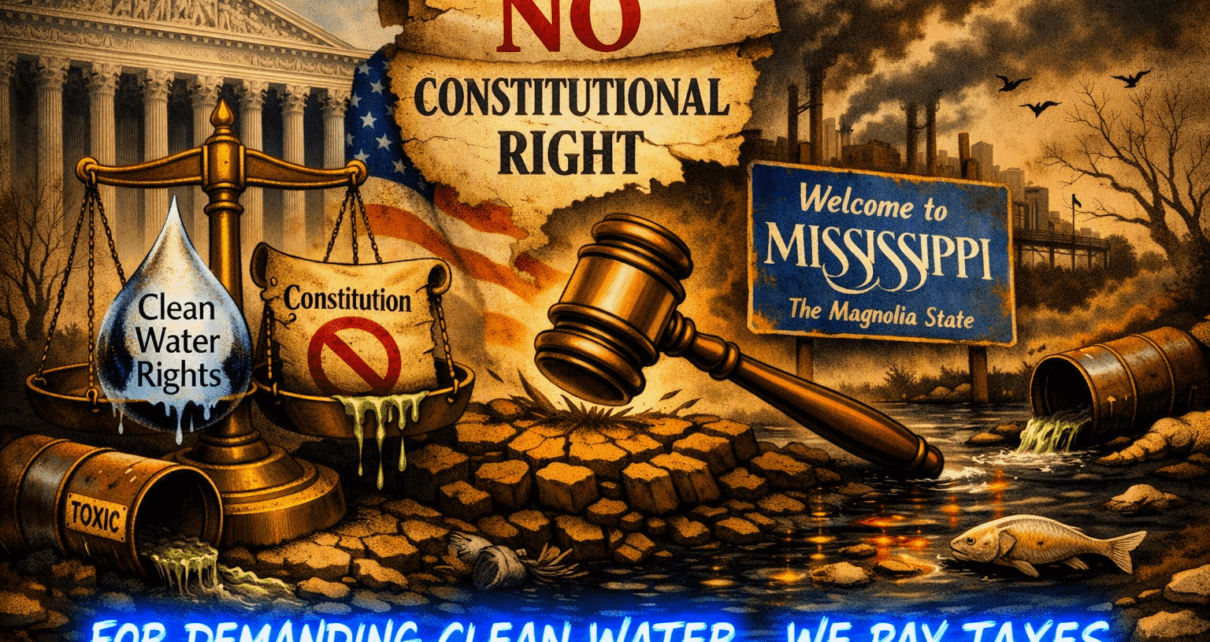
A US appellate court has decided that the federal constitution does not guarantee a right to clean water.
That legal opinion came in the form of a decision on Friday from the fifth circuit court of appeals to uphold a lower court’s dismissal of a 2022 lawsuit from several Jackson, Mississippi, residents claiming that tainted drinking water violated their constitutional rights.
Those residents of Mississippi’s capital city contended that their local drinking water was unsafe to drink because of high lead levels and other contaminants.
The New Orleans-based fifth circuit’s majority opinion held that the residents wanted “recognition of two new constitutional rights lacking any foundation in the history and tradition of our nation” – those being “the right to be free from exposure to contaminated water and the right to accurate information from public officials”.
In the majority’s view, residents should have gone about their legal fight for clean water another way, such as pursuing “tort claims” or by “electing representatives who will better manage the public-water system, and petitioning their representatives for other remedies”.
Tort claims allege “harms caused by others” while seeking “to impose liability on parties responsible for the harm, and to deter others from committing harmful acts”, according to Cornell University’s law school.
Friday’s decision also said that state and federal officials were working hard to improve the majority-Black city’s drinking water. The residents who filed suit alleged that public authorities had for years failed to mitigate lead levels and failed to inform them about an increase.

“Plaintiffs have not been left to go at it alone,” the court said. “The State of Mississippi and federal government have worked for years, and continue today, to improve the city of Jackson’s drinking water quality through regulations, investigations, and compliance plans.”
Meanwhile, the opinion also said: “It is undisputed that the Constitution does not guarantee clean water.”
The opinion also held that a state does not have a constitutional duty “to provide substantive services for those within its border absent a special relationship”. And municipalities are not constitutionally obligated to provide sewerage, water treatment or waste management services “in a reasonably competent fashion”, the decision said.
The decision nonetheless said that the majority of the court recognized the allegations of “serious government misfeasance” and was “sympathetic to the injuries [the plaintiffs] may suffer as a result”. But, the court’s ruling said “our sympathies cannot be the basis” for converting tort claims into constitutional issues.
“These deprivations, while grievous, do not infringe upon any deeply rooted constitutional right,” the fifth circuit’s opinion said.
Attorneys for the plaintiffs could not immediately be reached for comment. John Horhn, the Jackson mayor, said in a statement: “We are pleased that the fifth circuit upheld the dismissal of these claims.
“The City remains committed to the health, safety, and well-being of every Jackson resident.”
Jackson residents say that they have long reeled from water crises.
The NAACP filed a complaint in September 2022 alleging that Mississippi state authorities violated civil rights law by repeatedly sending federal money earmarked for drinking water safety to white communities rather than Jackson. Such diversion of funds constituted racial discrimination, the complaint said.
“The result is persistently unsafe and unreliable drinking water and massive gaps in the access to safe drinking water that are intolerable in any modern society,” Jackson residents said in a complaint to the federal Environmental Protection Agency (EPA). “Nearly all of the residents of Jackson have watched brackish, dirty, impure, and undrinkable water trickle from their taps. At times, some have had no water at all.”
The NAACP’s Jackson branch sued over the diversion of these funds in August 2025. The suit against several Mississippi state officials alleged that they “intentionally deprived [Jackson] residents … of access to federal relief funds … which were promised to Jackson in order to address the water infrastructure crisis”.
The lawsuit asked for a judge to declare that this diversion of money “is both facially discriminatory and the result of discriminatory purpose” – and to bar officials from permanently siphoning that money away from Jackson.
At this dangerous time
We hope you appreciated this article. Before you close this tab, can we ask you to support the Guardian at this critical time for journalism in the US?
According to a leading global watchdog, US democracy is now more imperiled than at any point since the 1960s. Press freedom is under threat on many fronts – from criminal investigations to politicized regulation, frivolous lawsuits and catastrophic funding cuts to public media.
With the midterm elections approaching, these attacks are accelerating. Donald Trump suggested that the host of Meet the Press should be “punished” by the FCC for making a factual statement he disliked. Trump is using the agency – which is supposed to be an independent regulator – to settle political scores: The FCC targeted ABC after Jimmy Kimmel made a joke about Melania Trump.
The Pentagon recently fired the editor of Stars and Stripes newspaper for “insubordination” shortly after they reported on a suicide attempt aboard the USS Lincoln. And the treasury department blocked individual reporters from the New York Times, the Wall Street Journal, and Bloomberg from G20 meetings, the latest attempt to handpick which journalists and outlets are given access to government proceedings.
Together these efforts make it more difficult to get fact-based reporting to US voters ahead of critical elections that will determine control of Congress and the future of Trump’s agenda.
Making matters worse, many of the US’s largest news organizations are now owned by billionaires whose personal and business interests may be at odds with safeguarding editorial independence. Media critics have observed how CBS News, now owned by a Trump ally, has softened its coverage; CNN could be taken over by the same billionaire; and Jeff Bezos has imposed extreme staff cuts and editorial interventions at the Washington Post.
When freedom is under attack, it falls to a determined few news organizations to ensure the full truth still reaches the public. The Guardian is owned neither by a billionaire nor a corporation and remains dedicated to keeping trustworthy journalism paywall-free for the world.
The Mississippi water crisis primarily refers to the severe, long-standing failure of the drinking water infrastructure in Jackson, Mississippi, the state capital, which was exacerbated by flooding in August 2022 that shut down the O.B. Curtis Water Treatment Plant. While the immediate emergency declarations have ended, the system remains under the management of a court-appointed private manager, JXN Water, due to decades of underfunding, aging pipes, and state-level neglect.
Current Status and Legal Context:
-
Ongoing Infrastructure Failure: Despite federal aid and emergency repairs, residents still face localized water disruptions, boil-water notices, and distrust of the water supply due to persistent reliability issues and past contamination events.
-
Legal Precedent: In September 2026, the U.S. Fifth Circuit Court of Appeals ruled that the U.S. Constitution does not guarantee a constitutional right to clean municipal drinking water, rejecting a lawsuit by Jackson residents who claimed their rights were violated by exposure to lead and contaminants.
-
Broader State Issues: The crisis in Jackson highlights a statewide pattern of environmental racism and infrastructure decay, with other areas like New Orleans also facing threats from saltwater intrusion due to low river levels, though the Jackson situation remains the most critical public health emergency.
Key Causes:
-
Aging Infrastructure: The city’s water system relies on pipes over 100 years old and has suffered from chronic low pressure, leading to contamination risks.
-
Systemic Neglect: State and local officials have failed to invest in necessary repairs for years, with the Mississippi State Department of Health historically ignoring warnings about lead levels and treatment failures.
-
Financial Mismanagement: A faulty billing system installed by Siemens in 2012 resulted in significant revenue loss and legal battles, further crippling the city’s ability to fund repairs.



 English