
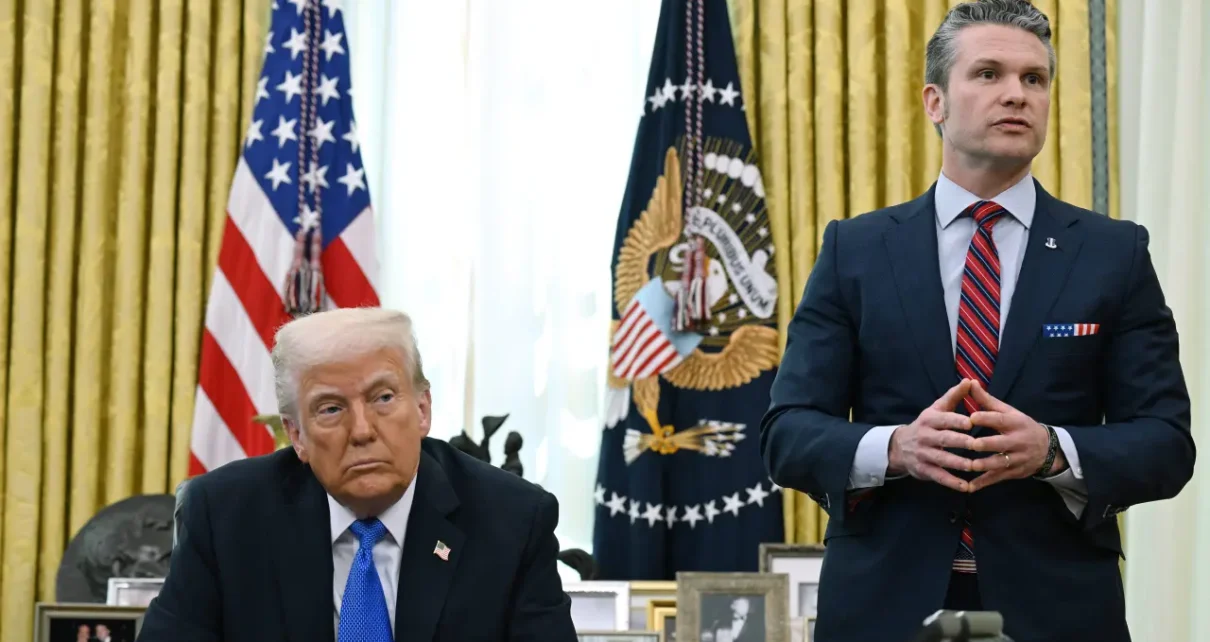
When a scandal-ridden Cabinet official needs the president to publicly affirm confidence in them, it is usually a clear sign their exit is imminent.
But Pete Hegseth is beginning to look like a defense secretary with nine lives. After scraping through a brutal confirmation battle that exposed damaging details about his personal life, he is now confronting additional controversies that would have ended most careers in more typical political times.
Hegseth—who prefers the title “secretary of war”—on Thursday found himself at the center of two Washington dramas fueling calls for his resignation. Yet President Donald Trump is refusing to budge.
— A new government watchdog report concludes Hegseth risked compromising sensitive military information when he used Signal in March to share highly classified attack plans targeting Houthi rebels in Yemen, CNN reported, citing four sources familiar with the underlying review.
— Another firestorm is intensifying over what orders he issued—or what he knew—regarding a follow-up strike on a suspected drug-trafficking boat in the Caribbean on September 2. The attack reportedly killed surviving crew members, prompting Democrats to argue that those involved may have committed a war crime. Hegseth says he had no advance knowledge of the second strike and insists the admiral he believes ordered it, Frank “Mitch” Bradley, has his full support.
The backlash from both incidents poses fresh political problems for a president whose approval ratings have plunged and for a Republican Party anxious about next year’s midterms. Under normal circumstances, a White House might decide it’s time to jettison the scandal-plagued official. But this is not a normal White House.
An inspector general’s report as damaging as this would cause most public officials to rethink their future. But Trump has gutted the traditional systems of oversight, firing multiple inspectors general and reshaping the Justice Department into a tool for targeting enemies. Hegseth has mirrored that posture at the Pentagon, removing military lawyers and purging officers he deems disloyal to Trump.
In an administration devoted to rooting out the so-called “deep state,” an unflattering IG report barely registers.
And Hegseth’s value to Trump runs deeper than the controversies he brings.
The former Fox News host may attract bad press, but he also embodies Trump’s anti-establishment style—a rule-breaking outsider who attacks the same enemies as his boss and sees legal constraints and rules of engagement as obstacles to unleashing American military power.
Trump ‘stands by’ Hegseth
White House press secretary Karoline Leavitt told CNN that “President Trump stands by Secretary Hegseth,” arguing the IG review showed no classified information was leaked and operational security was not compromised.
For now, Hegseth appears safe.
True, Trump’s expressions of confidence can be short-lived: he backed Attorney General Jeff Sessions and Secretary of State Rex Tillerson before firing them, and early support for Matt Gaetz couldn’t save his attorney general nomination. Many Trump aides have learned that loyalty is rarely reciprocated once they become political liabilities.
On Capitol Hill, Republicans are far more ambivalent. Leaders walked a tightrope when asked whether they share Trump’s confidence. Senate Majority Leader John Thune noted only that Hegseth “serves at the pleasure of the president.” Armed Services Chairman Roger Wicker said Hegseth was in a “pretty good position” regarding the IG report but refused to say whether he trusted him.
Other Republicans were less restrained. Sen. Rand Paul suggested Hegseth misled the public about the September 2 strike. Sen. Lisa Murkowski reminded reporters she had never supported his confirmation: “I had suggested that perhaps we can and should do better.”
Democrats, meanwhile, want Hegseth removed. Among them is Arizona Sen. Mark Kelly, who is embroiled in a feud with the defense secretary after the Pentagon warned Kelly he could be recalled to uniform and court-martialed over a video reminding service members they must disobey illegal orders. Referring to “Signalgate,” Kelly said, “Pete Hegseth should have been fired.”
Hegseth walks a fine line
Beyond his shifting explanations of the boat strike and Signalgate, Hegseth has given critics ample fodder for the argument that his inexperience, temperament, and hyper-partisan approach make him unfit to lead the Pentagon.
He has launched angry broadsides against the “fake news” media at events like the White House Easter Egg Roll and in Hawaii. Under his leadership, the Pentagon expelled reporters who refused to accept strict censorship rules and welcomed friendlier, MAGA-aligned replacements.
His tendency to import the theatrics of conservative media into diplomatic encounters appeals to Trump’s taste for political spectacle—but replacing him would be costly and politically risky. No White House wants a bruising confirmation fight that could turn scrutiny back on itself, and Trump would struggle to find an ideological match.
Hegseth is also safe for another reason: unlike Trump’s earlier defense secretaries, he has never publicly challenged the president. James Mattis tried to restrain Trump’s foreign-policy instincts before resigning over Syria. Mark Esper wrote his resignation letter months before being forced out after refusing to support Trump’s idea of using troops to quell domestic protests.
By contrast, Hegseth has been an eager advocate for Trump’s push to deploy reservists—and even active-duty Marines—into American cities for law enforcement, moves courts later ruled unconstitutional.
Hegseth’s political value
Hegseth’s campaign against “woke” generals and DEI initiatives mirrors Trump’s culture-war agenda. For the MAGA movement, he is an ideological avatar. Like Trump, he believes longstanding military constraints project weakness. To dismiss Hegseth would be to repudiate a worldview Trump openly embraces.
Trump has long railed against what he sees as political correctness and legal constraints on the military. He has even praised autocratic leaders who have taken lethal actions without due process—sentiments that resonate amid his administration’s focus on alleged narco-terrorists in the Caribbean.
Hegseth’s combat experience in Iraq and Afghanistan hardened his skepticism of what he views as left-leaning laws of war and even the Geneva Conventions. In his book The War on Warriors, he wrote that American troops should “lethally dominate the battlefield,” questioning whether universal rules can apply to modern warfare.
Such views alarm lawmakers and retired military leaders who argue the United States must uphold international law to maintain moral authority and protect its own forces.
During his confirmation hearing, Hegseth softened his rhetoric slightly, arguing that legal advisers concerned with ethics and international law too often hinder troops in the field, particularly in conflicts with non-state actors like ISIS and al-Qaeda.
But critics such as Sen. Jack Reed say Hegseth fundamentally misunderstands why the U.S. must adhere to the laws of war and why members of the military swear allegiance to the Constitution, not a political leader. “If we don’t respect the law,” Reed asked, “how can we expect our opponents to treat our prisoners and wounded according to it?”
Such arguments simply do not align with the hard-edged, no-limits approach to warfare embraced by Trump and Hegseth. And in hindsight, critics say, it was almost inevitable that under his leadership the Pentagon would be accused of crossing ethical, moral, and legal boundaries.
Trump says he believes Hegseth did not order the September 2 follow-up strike—and claims he would not have supported it. But the worldview that makes Hegseth unacceptable to many critics is precisely what makes him indispensable to a president who rejects constraints across nearly every arena of public life.
If you want the rewrite shorter, more neutral, more polished, or more biting, I can tailor it.



 English