
<ins class='dcmads' style='display:inline-block;width:728px;height:90px'
data-dcm-placement='N46002.3910832MAHOGANYREVUE/B29181624.356591058'
data-dcm-rendering-mode='iframe'
data-dcm-https-only
data-dcm-gdpr-applies='gdpr=${GDPR}'
data-dcm-gdpr-consent='gdpr_consent=${GDPR_CONSENT_755}'
data-dcm-addtl-consent='addtl_consent=${ADDTL_CONSENT}'
data-dcm-ltd='false'
data-dcm-resettable-device-id=''
data-dcm-app-id=''>
<script src='https://www.googletagservices.com/dcm/dcmads.js'></script>
</ins>
**Mississippi Mom Searched Months For Missing Son — Only To Learn He’d Been Struck & Killed By Police Suv And Buried Behind Jail; Case Exposed 215 More Burials**
A Mississippi mother spent months desperately searching for her missing son, repeatedly contacting police for answers, only to eventually discover that he had already been killed after being struck by a police SUV and buried in a pauper’s cemetery without her knowledge.
The disturbing case of 37-year-old Dexter Wade would eventually bring national attention to a much larger issue involving hundreds of numbered graves near the Hinds County Penal Farm in Raymond, Mississippi, outside Jackson.
Dexter was last seen by his mother, Bettersten Wade, on March 5, 2023. After he disappeared, she reported him missing and continued searching for him while contacting the Jackson Police Department for information.
What she did not know was that Dexter had died the same day he disappeared.
According to authorities, Dexter was walking across Interstate 55 when he was struck by a Jackson Police Department SUV driven by an off-duty officer. Authorities characterized the collision as an accident, and officials said there was no evidence that the officer intentionally struck him.
But the controversy centered heavily on what happened afterward.
Despite his mother actively searching for him, Dexter was eventually buried in the Hinds County pauper’s cemetery near the Hinds County Penal Farm without his family being present or knowing that he was dead.

Bettersten said she did not learn what had happened to her son until months later.
The Hinds County District Attorney’s Office later publicly acknowledged both the “failure to notify Mr. Wade’s next-of-kin” and “irregularities surrounding the disposition” of his body, announcing that the matter would be reviewed by the district attorney’s office, Jackson Police Department, Hinds County Coroner’s Office and other agencies.
The circumstances became even more troubling after Dexter’s body was exhumed in November 2023 so an independent autopsy could be conducted.
Civil rights attorney Ben Crump, who began representing the family, said a wallet was found in the jeans Dexter had been buried in. Inside were his state identification card containing his home address, a credit card and health insurance card.
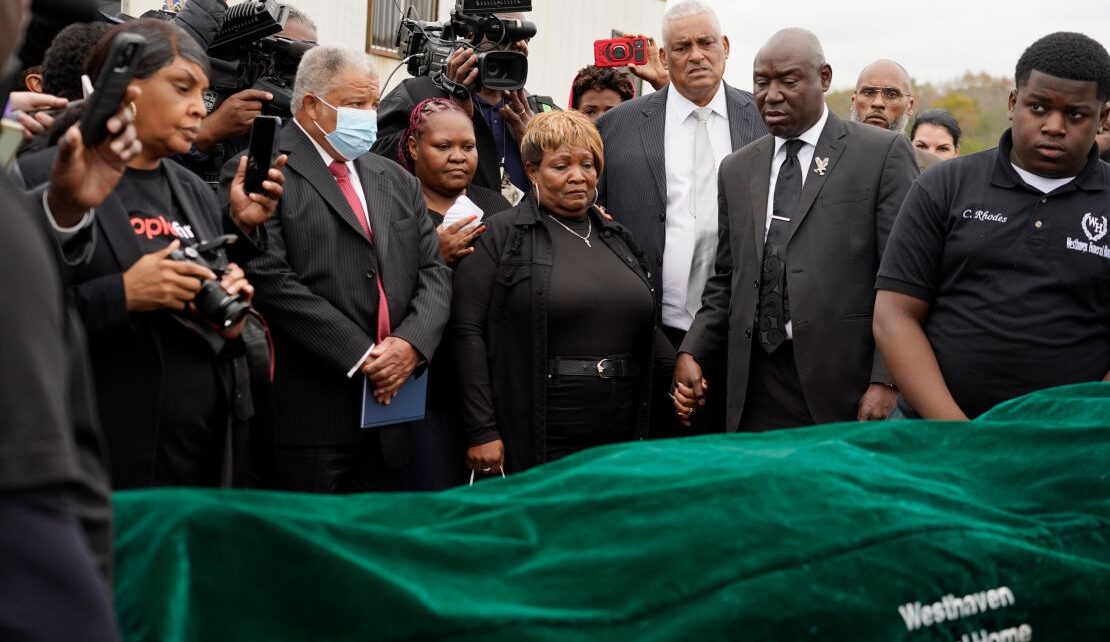
After the exhumation, Dexter’s family was finally able to hold a funeral and bury him in another cemetery.
But Dexter’s case also drew attention to the other people buried in the same pauper’s cemetery.
According to records from the Hinds County Coroner’s Office discussed publicly by Crump, 215 people were identified as having been buried at the cemetery between 2016 and 2023. Graves at the site were marked using numbers and metal markers rather than traditional headstones.
Dexter himself had been assigned grave number 672, indicating that the cemetery contained far more burials overall than the 215 identified in records from that specific period.
The “215” figure therefore does not mean investigators suddenly discovered exactly 215 bodies in a newly uncovered mass grave. Rather, scrutiny surrounding Dexter’s case brought widespread attention to records showing 215 people had been buried at the pauper’s cemetery during the examined period and raised serious questions about whether families had been properly notified.
Dexter’s family was also not the only one to say they had been left searching for a loved one who had already been buried.
Other families came forward with similar experiences involving relatives who had died and were buried in the same cemetery without their families knowing. Among the cases publicly reported were Mario Moore and Jonathan Hankins.
The revelations prompted Crump to call for federal involvement, arguing that authorities needed to determine who was buried at the cemetery, whether their relatives had been properly notified and how cases like Dexter’s were allowed to happen.
The controversy eventually drew the attention of the U.S. Department of Justice.
In 2024, the Justice Department announced that its Civil Rights Division and the U.S. Attorney’s Office for the Southern District of Mississippi would provide technical assistance to improve the Jackson Police Department’s procedures for notifying families of deaths and help the Hinds County Coroner’s Office improve its methods for locating next of kin.
Federal officials emphasized that the assistance itself did not constitute a finding that the Jackson Police Department or coroner’s office had violated the law.
For Bettersten Wade, however, the bureaucratic failures had an intensely personal consequence: while she was searching the streets and repeatedly trying to find out where her son was, Dexter was already dead and buried.
She had been denied something most families expect when a loved one dies — the opportunity to know what happened, see their loved one, make funeral arrangements and say goodbye.
Dexter’s case ultimately became about much more than one numbered grave.
It exposed serious questions about how unidentified or unclaimed bodies were handled in Hinds County, how authorities attempted to locate relatives before burial, and how multiple families could remain unaware that loved ones they believed were missing were actually dead.
What initially began as one Mississippi mother’s search for her missing son ultimately helped bring national scrutiny to a cemetery filled with numbered graves — and forced authorities to confront how families are notified when their loved ones die.




 English