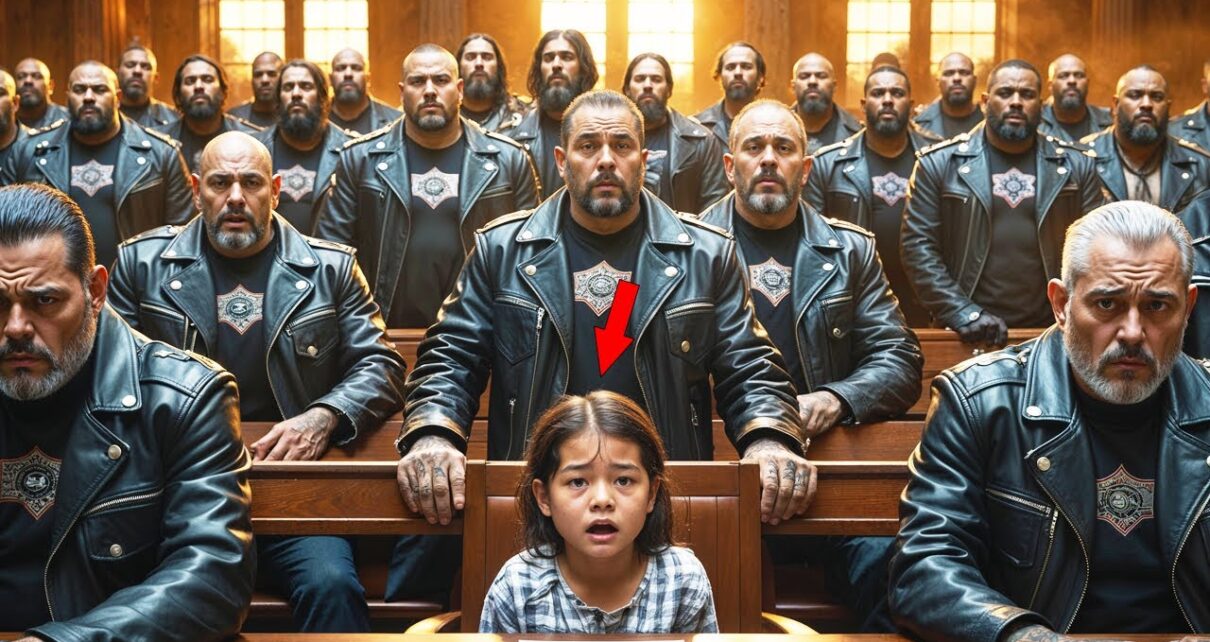
The story of 100 bikers surrounding a courthouse after a judge sent a beaten child back home is a viral internet narrative or creative fiction rather than a verified news event. Search results for this specific headline primarily lead to Facebook posts and clickbait articles that repackage a similar but distinct story involving 47 bikers protecting a 15-year-old girl named Maya from her father, a police sergeant accused of abuse.
In the verified 47-biker variant, titled “47 bikers surrounded a courthouse when a cop tried to reclaim his abused daughter,” the bikers (including clubs like the Iron Guardians and Veterans of Steel) entered the courtroom to support Maya after her foster mother was detained on fabricated charges. This act of solidarity reportedly influenced Judge Brennan to keep Maya in foster care for further review.
This narrative draws inspiration from real-world organizations like Bikers Against Child Abuse (BACA) and Guardians of the Children, which actually escort abused children to court to provide safety and support. However, the specific details of “100 bikers” and the “sent back home” outcome appear to be exaggerated or fictionalized versions of these real protective efforts, often circulated on social media without factual grounding.
THE STORY
The judge looked at a seven-year-old girl with cigarette burns on her arms and sent her home to the man who put them there.
I was in the courtroom when it happened, sitting in the back row in my vest and boots, trying to keep my mouth shut while the system failed a child right in front of me.
Her name was Lily. I won’t use her last name. She deserves that much.
I met her through our club’s child advocacy program. We work with protective services, schools and foster families. We ride with kids to their hearings so they know they’re not alone.
Lily had been in foster care for four months. She was taken from her father’s home after a teacher noticed the burns. She also had bruises on her ribs and a fracture in her left wrist that healed wrong because nobody took her to a doctor.
She was safe now. She was smiling again, and she’d started calling her foster mom “Mama.”
Then her father got a lawyer, a good one. He argued that protective services had overstepped, and he brought character witnesses who called him a “devoted single father going through a hard time.”
The judge found procedural errors in the removal. He ruled that the evidence had been improperly collected and ordered Lily returned to her father immediately.
She was sitting on a bench outside the courtroom in a yellow dress her foster mom had bought her when they told her. She didn’t scream or cry. She just went still, like something inside her shut off.
I walked out of that courthouse and called Danny, our club president.
“We have a problem,” I said.
“How big?”
“Get everyone. Every brother. Every club that owes us a favor.”
“When?”
“Tomorrow morning. Six AM. Dayton County Courthouse.”
Danny didn’t ask why. He just said, “Done.”
By 5:45 the next morning, there were a hundred motorcycles in that parking lot. Brothers from six different clubs had driven through the night because a child needed them.
We didn’t go there to threaten anyone or break laws. We went to make sure that courthouse understood we were watching, and we weren’t going away.
Judge William Harker was sixty-three years old and had spent thirty years on the family court bench. He came out the side door at 8:15 AM carrying a briefcase and a coffee, and he stopped when he saw us.
A hundred men in leather stood in silent rows with their arms crossed. Our bikes were lined up behind us like a wall of chrome and steel.
Harker looked at us for a long time. Then he straightened his tie and started toward his car.
Danny stepped forward. Just one step.
“Judge Harker.”
“Can I help you?”
“You sent a seven-year-old girl back to the man who burned her with cigarettes.”
“That case was decided based on the law and the evidence presented. I don’t discuss rulings with—”
“We’re not asking you to discuss anything,” Danny said. “We’re telling you we’re watching. That little girl has people now. People who will notice if something happens to her.”
Harker’s face went red. “Are you threatening me?”
“No sir. We’re promising her.”
A news van pulled in, then another. Someone had tipped them off, and the cameras started rolling.
“This is inappropriate,” Harker said.
“So is sending a beaten child home to her abuser,” Danny said.
Harker walked to his car without another word. His hands were shaking when he opened the door.
We stayed until noon and talked to every reporter who asked. We told them about Lily, the burns, and a judge who chose a technicality over a child’s safety. By that evening it was on every local news channel, and by the next morning it was trending online.
But anger doesn’t change court orders. We needed a plan
That afternoon I called Diane Marsh, a family law attorney who’d handled abuse cases for twenty years. She agreed to take Lily’s case pro bono.
“The ruling isn’t wrong on the technicality,” she told me. “Protective services made mistakes in the removal process. The judge had legal grounds. We file an emergency appeal, but we need new evidence. If the father does anything that suggests Lily is in danger, we can petition for emergency removal under a different statute.”
“So we wait for him to hurt her again?”
Diane was quiet for a moment. “I know how that sounds. But the law requires evidence. We can’t act on what we think will happen. Only what does happen.”
That kept me up at night. The system was broken, but it was the only system we had.
We set up a watch rotation, but not outside the father’s house, because that would be harassment. We had brothers in every part of town who could drive by and notice things.
Lily’s teacher, Mrs. Guerrero, was the one who’d reported the original abuse. “I’ll watch her,” she said. “Every day. I’ll document everything.”
The Warners, an older couple next door, had heard yelling and crying through the walls before. “We called the police once but nothing happened,” Mrs. Warner said.
“If you hear anything now, you call us first,” Danny said. “Then the police.” We gave them our number.
Lily’s foster mother, Karen, couldn’t stop crying when we met her. “She called me Mama,” she said. “She finally felt safe. And they put her in his car like it was nothing.”
“We’re going to get her back,” I said.
“How?”
“I don’t know yet. But we will.”
It was a promise I wasn’t sure I could keep. I made it anyway.
The next two weeks were the longest of my life.
On the third day, Mrs. Guerrero called. Lily wouldn’t talk to anyone or eat lunch, and she was wearing long sleeves even though it was warm. When Mrs. Guerrero reached for her, she flinched.
Diane said behavioral changes weren’t enough. We needed physical evidence or a direct disclosure from the child. That meant a seven-year-old who had already told someone and been sent back anyway now had to tell a stranger.
On day eight, Lily drew a family portrait in class. She drew herself alone in a dark closet, with the door locked from the outside.
“Diane says it helps build a pattern,” Mrs. Guerrero told me. “But it’s not enough.”
On day eleven, the Warners called Danny at midnight. “He’s screaming at her,” Mr. Warner said. “We can hear her crying.”
“Call 911. Right now. We’re on our way.”
Six of us rode over in twelve minutes. The police had arrived in eight. The father answered the door calm and polite. Lily was in bed with no visible marks.
“She had a nightmare,” he said. “I was trying to calm her down.”
The police left. I sat on my bike outside for an hour, staring at the nightlight glowing behind her curtain. I have never felt so helpless.
Day fourteen was a Thursday. Mrs. Guerrero called at 7:30 AM, crying. I got there in fifteen minutes.
“She took off her sweater in class,” she said. “It was hot and she forgot. There are new burns on her upper arm. Maybe two or three days old.”
She’d already called protective services. She had photographed the burns before Lily pulled her sweater back on, telling her she was taking pictures of everyone’s outfits for a class project. Lily said she spilled soup on herself, but the burns were circular and uniform, the same pattern as before.
I called Diane from the parking lot.
“New injuries documented by a mandated reporter with photographs,” she said. “Plus the behavioral records, the drawing, the neighbor testimony, and the previous abuse pattern. I’m filing within the hour. And this time I’m going to Judge Reeves in the next district.”
Judge Patricia Reeves signed the emergency removal order at 2:15 PM. By 3:00, a social worker and two police officers were at the father’s door. By 3:30, Lily was out.
Danny and I were parked across the street, not saying a word, just there. Lily came out in long sleeves, holding a plastic bag of clothes. She saw us and walked over to Danny’s bike. She didn’t smile, but she put her hand on the gas tank.
“Are you going to take me to Mama?” she asked.
“That’s exactly where you’re going,” the social worker said.
Danny rode escort behind the social worker’s car, and I followed Danny. We rode slow, like we were carrying something precious.
Karen had been called twenty minutes earlier and was waiting on the porch. She knelt and opened her arms. Lily ran faster than I’ve ever seen a seven-year-old move and hit her so hard they both nearly fell over.
“Mama,” Lily said.
Danny and I sat on our bikes in the street, two grown men in leather crying like children.
The father was arrested the following week. The new burns, the photographs, the school records and the neighbor statements gave the prosecutor everything she needed. He was charged with aggravated child abuse. He pleaded not guilty, then changed his plea to guilty when his lawyer saw the evidence file. He got seven years. That isn’t enough, but it’s seven years of Lily not being afraid to fall asleep.
The state judicial board reviewed Harker’s ruling after the media coverage led other families to come forward. He wasn’t removed, but he was moved from family court to civil disputes. Diane told me our demonstration was cited in a state legislative hearing on reforming child protective services.
“You helped change how the system works,” she said.
I didn’t do it for the system. I did it for a little girl in a yellow dress who went still when the world told her she didn’t matter.
Lily has been with Karen for a year now, and the adoption was finalized in March. Our club still shows up for her birthday parties, school events and softball games. Fifteen bikers at a seven-year-old’s softball game is a sight, I’ll tell you that. She’s louder and bossier now. Last week she told Eddie his beard was “ridiculous” and he needed to “get it together.” He laughed so hard he almost fell off his bike.
Her scars will never go away, but she isn’t hiding them anymore. At field day last month she wore a tank top for the first time since we’d known her. Mrs. Guerrero sent me a photo of Lily running a relay race with her scars showing, grinning like the whole world belonged to her. I keep it in my vest, right over my heart.
Danny says the system would have caught up eventually. Maybe. But eventually meant more burns, more closets and more long sleeves in warm weather.
We came. A hundred of us, standing in a parking lot at six in the morning to say a child’s safety matters more than a technicality.
That’s not a threat. That’s a promise. We’re watching, and God help the person who hurts one of our kids.
Because they are our kids. Every single one. That’s the brotherhood.
And Lily knows now that a hundred men in leather will show up for her.
New Jersey Rep. LaMonica McIver pleaded not guilty Wednesday on charges of assaulting, impeding and interfering with law enforcement related to a clash at the ICE detention facility at Delaney Hall in Newark. McIver’s supporters, including Newark Mayor Ras Baraka and immigrants rights groups, rallied outside of federal court in Newark to call for the charges to be Read More…
Dakari Davis, Black Policeman with the DART Police Department in Dallas, Texas, says he is upset and confused after being told that his braided hairstyle is “unprofessional” by a lieutenant, which ultimately led to him being reprimanded. Davis, who began serving in law enforcement in 2019, says that he could not believe it when one Read More…
His new project about African samurai Yasuke will appear on Netflix this spring By Paul Wachter LeSean Thomas is the creator, producer and director of Yasuke, an anime series about a Black samurai. Fabian Parkes The protagonist of Netflix’s new anime series, Yasuke, is a true historical oddity: an African who entered 16th-century Japan with Read More…



 English


