
8888888888888888888888888888888888888888888888888888888888888888888888888888888888888888888888888888888888888888888888888888888888
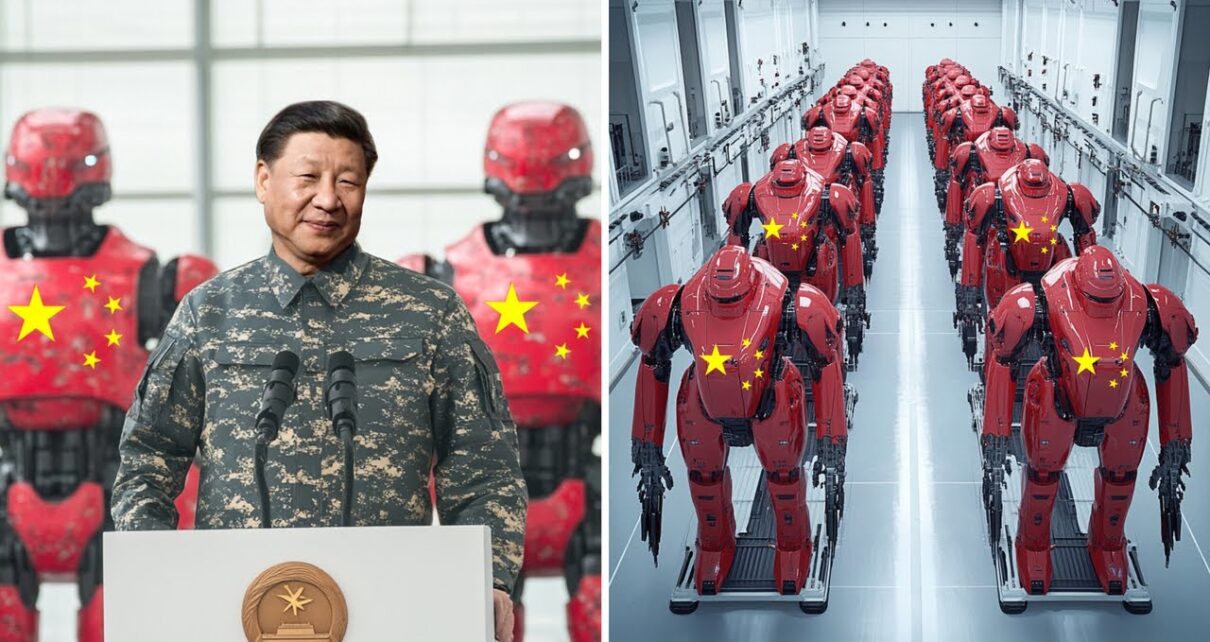
China’s People’s Liberation Army is actively training humanoid robots for urban combat, reconnaissance, and sentry duty — with state defense giant Norinco already producing a combat-ready model called Fuxi. Here’s what the PLA’s robot program looks like, who’s building the machines, and what this means for the future of warfare.

- China’s PLA is training humanoid robots for urban combat, reconnaissance, and base security — with a timeline of 5–10 years for practical battlefield deployment.
- Norinco, China’s state-owned defense giant, built the Fuxi humanoid robot capable of sentry duty and teleoperated combat tasks.
- The US Army launched a competing humanoid military program but trails China in humanoid manufacturing volume — Chinese firm Unitree shipped roughly 95% of global humanoid units in 2025.
- Current robots remain too energy-hungry and unreliable for real battlefield conditions, but the pace of investment is accelerating rapidly.
Last month, a Chinese humanoid robot did a backflip at a tech expo in Shenzhen. This week, Reuters reported that robots from the same manufacturer are being evaluated for military combat. The jump from dance floor to battlefield happened faster than most defense analysts predicted — and it raises questions that go far beyond technology.
China’s People’s Liberation Army isn’t just experimenting with robots as a novelty. It’s running structured military competitions, publishing doctrines on autonomous combat, and funding the hardware to make it real. Here’s what’s actually happening, who’s building the machines, and why this matters more than any single weapons program in decades.
What the PLA Is Actually Building
The most concrete military humanoid project comes from Norinco — China’s largest state-owned defense conglomerate, responsible for everything from tanks to missile systems. Norinco’s Fuxi humanoid robot can perform sentry duty, reconnaissance missions, and handle dangerous tasks that would otherwise put human soldiers at risk.

Fuxi operates via teleoperation, meaning a human operator controls it remotely rather than the robot acting autonomously. That’s an important distinction. The robot doesn’t decide what to do on its own — it follows human commands relayed through a control interface.
But the PLA’s ambitions go further. China’s Academy of Military Sciences published research proposing that humanoid missions could evolve “from supporting combat toward primary combat.” A PLA Daily article from July 2025 went further, suggesting robots could eventually be authorized to “fire on a living target that had been verified by a human.”
That’s a carefully worded statement — it keeps a human in the decision loop while acknowledging that the end goal is robots engaging targets directly.
The Urban Warfare Scenario
The PLA’s National University of Defense Technology (NUDT) — the military’s top research institution — has been hosting competitions that simulate a specific scenario: six combat robots clearing an enemy-occupied building floor by floor alongside ground troops.

The robots in this scenario include humanoids, quadruped “robot dogs,” and unmanned ground vehicles. Each type handles a different role — humanoids enter rooms and identify threats, robot dogs provide situational awareness, and unmanned vehicles carry supplies or heavy weapons.
This isn’t theoretical. NUDT’s competitions use real hardware in controlled environments, testing how well robots navigate stairs, doorways, and unpredictable obstacles. The results feed directly into PLA training doctrines.

Separately, the PLA Eastern Theater Command released an AI-generated propaganda montage depicting military robots overwhelming Taiwan’s defenses. Whether that reflects actual capability or aspirational messaging is debatable, but it signals that the PLA wants both domestic and foreign audiences to take its robot ambitions seriously.
The Manufacturing Advantage
Here’s where China’s position gets concerning for competitors. Unitree Robotics, the Chinese firm that makes the dancing humanoids you’ve seen in viral videos, shipped roughly 95% of all humanoid robots globally in 2025. That’s not a typo — one country’s one company dominates global humanoid production by an overwhelming margin.
Unitree’s commercial robots are designed for entertainment and research, not warfare. But the manufacturing expertise, supply chains, and engineering talent that produce commercial humanoids can be redirected toward military applications. China’s civil-military fusion policy explicitly encourages this kind of technology transfer — it’s not a hypothetical concern but a stated government strategy.
The PLA budgeted approximately $300,000 in June 2026 specifically for camera, radar, and motion data collection systems — the exact components needed to train robots for battlefield perception. That budget is small by military standards, which suggests it’s one line item in a much larger classified program.
What the Robots Can’t Do Yet
Let’s be honest about the limitations. Current humanoid robots are energy-intensive, unreliable outside controlled environments, and can’t handle the chaos of a real battlefield.

Dennis Hong, a mechanical engineering professor at UCLA, told Reuters that “going where we don’t want humans to go is one of the most compelling reasons to develop robots.” But he wasn’t claiming the technology is battle-ready.
The key challenges:
- Battery life: Most humanoid robots operate for 1–2 hours on a charge. A military operation lasting 12+ hours requires either swappable power packs or a breakthrough in energy density.
- Terrain adaptation: Dancing on a flat stage is different from navigating rubble, mud, stairs, and uneven terrain under combat conditions.
- Decision-making: No current AI system can reliably distinguish between a civilian and a combatant in the split-second timing that urban combat demands. The ethical and legal implications of getting this wrong are enormous.
Researchers project practical battlefield deployment in 5–10 years. That timeline is aggressive but not unrealistic given the pace of AI and robotics development.
The Global Arms Race Response
The US isn’t sitting still. The US Army launched a competition for militarized humanoid capabilities, offering up to $1.25 million in contracts to American robotics companies. But the American robotics industry — while strong in software and AI — trails China significantly in two-legged and quadruped machine production.
China’s advantage isn’t just volume. It’s the integration of commercial robotics innovation with military applications through government policy. Companies like Unitree and UBTECH develop commercial products that generate revenue and attract talent, while the PLA draws on that same ecosystem for military R&D.
The Russia-Ukraine conflict also accelerated this race. Reuters previously documented how China studied autonomous drone warfare in Ukraine to inform its own unmanned combat strategy. Humanoid robots are the next logical step — ground-based autonomous systems that can operate in environments where drones can’t reach.
The Bigger Question Nobody’s Answering
The technical debate about whether robots can clear a building or fire a weapon is important, but it misses the larger issue. Who decides when a robot can use lethal force?

International humanitarian law requires a human to make targeting decisions. China’s current approach — teleoperation with human verification — technically satisfies this requirement. But as AI capabilities improve and latency becomes a tactical disadvantage, the pressure to remove the human from the loop will intensify.
No country has signed a binding international agreement restricting autonomous lethal weapons. The UN Convention on Certain Conventional Weapons has discussed the issue since 2014 without reaching consensus. Meanwhile, the technology keeps advancing.
Wang Yonghua, a researcher at China’s Academy of Military Sciences, put it bluntly: “Humanoid robots will stream onto the battlefield” once manufacturing costs drop and technical breakthroughs arrive. The question isn’t if — it’s under what rules.
FAQs
Can humanoid robots actually fight in a war right now?
Not yet. Current humanoid robots operate for 1–2 hours on a charge and struggle with unpredictable terrain. China’s military researchers project 5–10 years before practical battlefield deployment, assuming continued investment in battery technology and AI navigation.
What is China’s civil-military fusion policy?
It’s a government strategy that encourages private-sector technology companies to share innovations with the military. Commercial robotics firms developing consumer products can be directed — or incentivized — to adapt their technology for defense applications.
Is the US developing military robots too?
Yes. The US Army launched a competition offering up to $1.25 million for militarized humanoid capabilities. However, the American robotics industry focuses more on software and AI, while China dominates hardware manufacturing and leads in humanoid robot production volume.
Are there international laws against killer robots?
There’s no binding international treaty specifically banning autonomous lethal weapons. The UN has discussed the issue since 2014, but major military powers — including China, the US, and Russia — haven’t agreed to restrictions.
What companies are building China’s military robots?
Norinco (a state-owned defense conglomerate) builds the Fuxi combat humanoid. Unitree Robotics produces commercial humanoids that share underlying technology with military R&D. The National University of Defense Technology runs testing competitions for military robot applications.




 English